
2021 Conservation Management Plan
The 2021 Conservation Management Plan. This plan has not been published. It is deeply conflicted. In 2019, the consultant published a proposal to expand the Tennis courts and remove an elm avenue, noting that this elm avenue was a ‘constraint’. No wonder the same consultant downgraded the significance of the Elms and this specific Elm Avenue, based on a dubious argument about the date the avenue was constructed (1885).
The same consultant’s earlier report (see below) identified the Avenue and the Elms as of Primary Significance to the Edinburgh Gardens.
The report is a 38 Mbyte file. If t is too big you can access it in 4 parts.
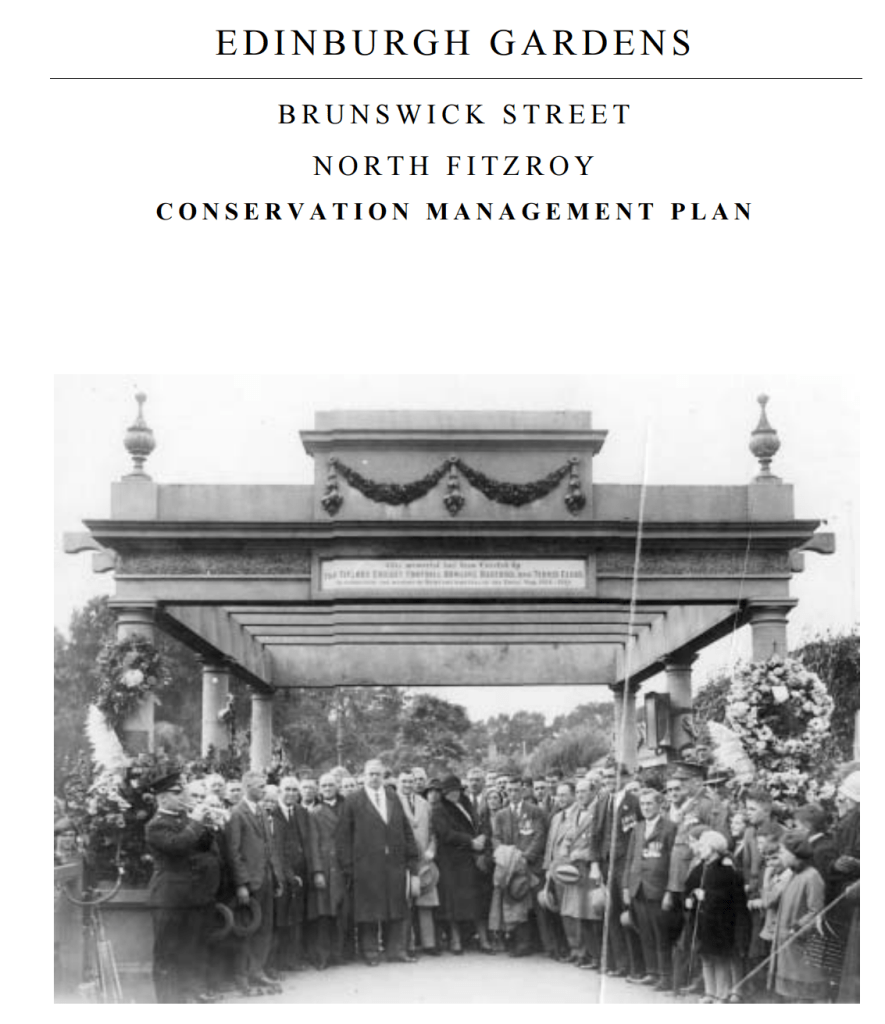
EDINBURGH GARDENS BRUNSWICK STREET NORTH FITZROY – CONSERVATION MANAGEMENT PLAN 2004
Allom Lovell & Associates, Conservation Architects,
In association with John Patrick Pty Ltd
Conclusion
Activities which have potential to affect the fabric of the Gardens should be discouraged.
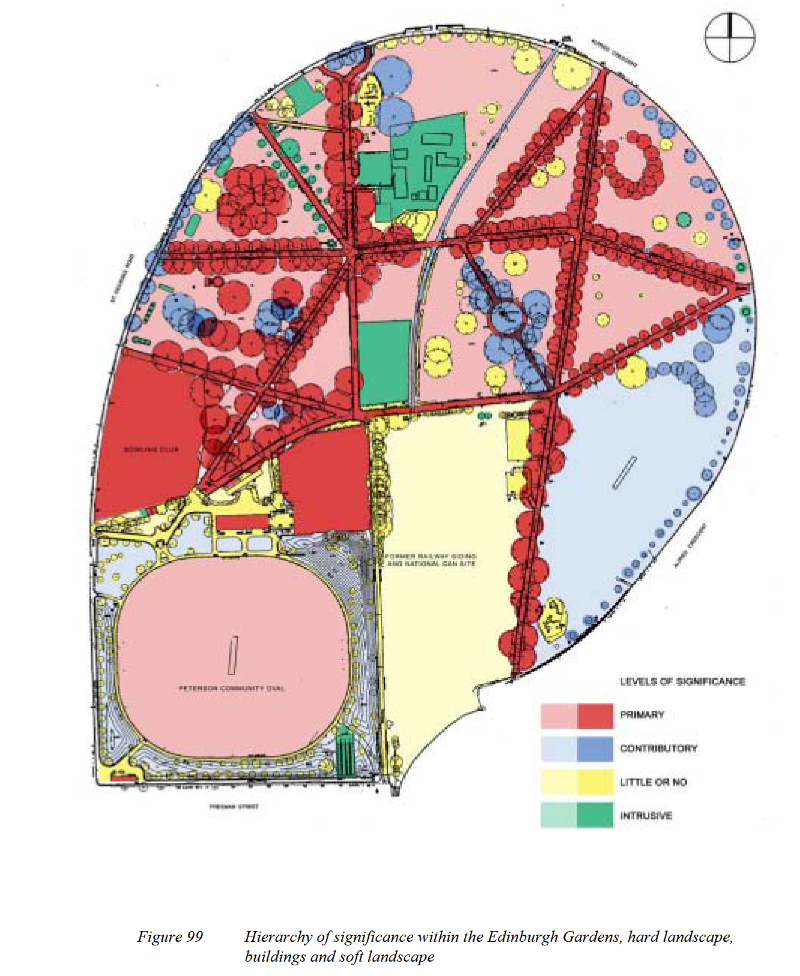
The assessment concludes that the Edinburgh Gardens are of historical, social and aesthetic significance to the City of Yarra. The elements and areas of primary significance include the Elm avenues and rows throughout the Gardens, the Peterson Oval (former Fitzroy Cricket Ground), the English Oak Avenue opposite Rowe Street, the Holm Oak specimen and the remnant Dutch Elm circles. With regard to buildings and hard landscaping features, those of primary significance are the grandstand, the principal nineteenth century path layout and remnant basalt edging, the Freeman Street entrance gatehouse, the timber entrance pavilion, cast iron gas lamp standards and nineteenth century cast iron bollards, the tennis club pavilion and courts (excluding fabric of courts), the Fitzroy Bowling Club (excluding fabric), the war memorial arbour, the Chandler drinking fountain, the pedestal of the Queen Victoria statue and the memorial rotunda.
The conservation policy recognises that continued use of the Edinburgh Gardens for public and private recreation is fundamental to its cultural significance. The conservation policy also recognises that whilst the Edinburgh Gardens retains significant nineteenth and early twentieth century elements, they have in many other respects changed from their nineteenth century appearance. Because of this layering, or co-existence of significant elements, the policy does not encourage favouring one particular phase in the history of the Gardens over others. Policies are instead directed towards conserving significant elements and features from a variety of periods in the history of the place and to remove others, while allowing for some new elements. Overall they are intended to conserve, enhance and recover lost elements of
Significance in the Gardens [CMP2004]
The Edinburgh Gardens is distinctive because of its limited planting palette with its almost exclusive reliance on a single taxon, Dutch Elm (Ulmus x hollandica) for its avenues, and small number of taxa overall. Historically, it did have some ‘gardenesque’ elements with the scalloped garden bed and the Queen Victoria memorial shrub beds, however these have since been lost. The Edinburgh Gardens possibly has more in common with the formality of layout and simplicity of planting palette found in many French formal gardens
Several other factors contribute to the aesthetic appeal of the Edinburgh Gardens. These include the nineteenth century character of the northern half of the reserve, mature avenues of elms, a small number of significant specimen trees, views and vistas, the oval and the large ‘oasis’ of green parkland in the built up inner city location.
In summary, the Edinburgh Gardens have pleasant aesthetic qualities which make them a valuable open space within the City of Yarra and inner suburban Melbourne. They have retained a strong nineteenth century character exhibited in their layout, plantings, memorials and recreational facilities which have endured, notwithstanding later phases of development.
This is perhaps its greatest strength.
The Edinburgh Gardens are aesthetically significant. They derive their aesthetic significance from their landmark qualities of a large expanse of green within the built-up inner suburbs and their avenue network of mature plantings which impart delightful internal vistas on the space. The focal points of a small number of garden structures also combine to provide an enduring nineteenth century character. The Edinburgh Gardens are unusual as an example of a nineteenth century garden which cannot be characterised into typical Victorian styles of garden design such as the picturesque or gardenesque. The Gardens are the most outstanding example, and one of only two formal nineteenth century gardens, in the former City of Fitzroy and present City of Yarra.
Established for over 140 years, the Edinburgh Gardens are of social significance because of their enduring focus of community use and high regard in which they are held. The Gardens’ continuing social importance and popularity is heightened by its accessibility and provision of passive and active recreational facilities within a dense urban setting and provision for community interaction.
Significance of Tennis Club
The tennis club has an intrinsic historical association with the Edinburgh Gardens, having occupied its present site since c.1888. It is demonstrative of the leisure pursuits of the community since the nineteenth century and which remain popular today. Like other such facilities in the Gardens, it occupies a place in the broader thematic history of the Gardens and the Fitzroy area. The clubhouse, though possibly dating from the early twentieth century, has been modified and apparently relocated variously in the vicinity of the tennis courts. The building is one of the older elements in the Gardens and is similar to the example in the Carlton Gardens.
The tennis courts have been altered and resurfaced a number of times and as such their fabric is considered to be of little or no significance. However their existence and location date from at least 1901 and as such they are demonstrative of the leisure pursuits of the local community since 1888. As an entity the tennis courts and pavilion are considered to be of primary significance. [CMP]
Significance of Paths
With the exception of the removal of a number of secondary paths and the alteration to paths around the community oval, the main path network through the Edinburgh Gardens remains essentially unchanged since its creation in the 1880s and 1890s. The principal path structure is of primary significance to layout, but not the majority of materials. However, remnant early basalt scoria rock path edging is of contributory significance. [CMP]
Significance of the Elm Avenues
The Elm avenues are of primary significance as a major element of Edinburgh Gardens which dates from its early development in the mid-1880s to the early 1900s, and which remains substantially intact. The Elms are also significant as the overwhelmingly dominant species in the early planting scheme. The almost exclusive reliance on a single species is unusual in
Melbourne’s nineteenth century parks and gardens where a broader planting palette was typical. The Elm avenues are also significant as a good example of a traditional ornamental use of this species; which is increasingly rare with the loss of most European and North American examples as a result of Dutch Elm Disease [CMP pg83]
Edinburgh Gardens Landscape Study 1987
By Rex Swanson for the City of Fitzroy.
A scan of the original report has been published by the City of Yarra.
Rex Swanson Landscape Study 1987. However the text is not searchable.
Here is an electronic conversion of that report, which is searchable. It may have some conversion and formatting inaccuracies caused by the conversion process.
While the 2004 Lovell Chen Conservation Management Plan was equivocal about the heritage value of the former railway line, the earlier Swanson landscape study pulled no punches, opening with
“As the only substantial area of parkland in Fitzroy, the Edinburgh Gardens deserve particular care. This has not always been the case in the past, and in fact the Gardens have a long history of abuse and alienation of land to other purposes of which the worst episode was sub-division for the State Railways in the late 1880s. Now that the railway has at last been removed, the City is presented with a golden opportunity to reverse this decline and restore the Gardens to their proper role as a well integrated and attractive inner city park serving the passive and active recreation needs of the local community. That is the central theme of this report”The Fitzroy Tennis Club occupies a site of 3r 37p (0.41 hectare), a part of the old cricket club reserve. A formal lease agreement is not at present in force between the Club and the City, but rates are paid. Site improvements are principally the six en-tout-cas courts, the clubhouse and the enclosing fence. The club is unobtrusively sited in the area behind the grandstand and the mound; avenue elms and peripheral landscaping partly screen it from view.The club is a good example of an intensively used sporting facility that has been intelligently sited and grouped with other sporting facilities to preserve the open space values of the surrounding parkland.”
Without doubt, the best feature of the Gardens today is the canopy of mature exotic trees that dates in large part from the late nineteenth century. These trees are mostly planted in avenues along the path system of slightly earlier date which links to the surrounding streets and perpetuates the through-passage needs of the pedestrians of that era. Paths and trees provide the basic design and structure of the park which, although pragmatic in origin and essentially uninspired, are characteristic of many of the simpler town parks of its period and well worth preserving.
Edinburgh Gardens Citations in
North Fitzroy Heritage Study – Jacob Lewis Vines 1978
The oldest heritage study in the City of Yarra, according to Council’s timeline.
The North Fitzroy Heritage Study by Jacob Lewis Vines, included citations for the Edinburgh Gardens. Scanned copy published by the City of Yarra.
Here is a version of the scanned document with OCR
2003 Edinburgh Gardens Master Plan, Patrick
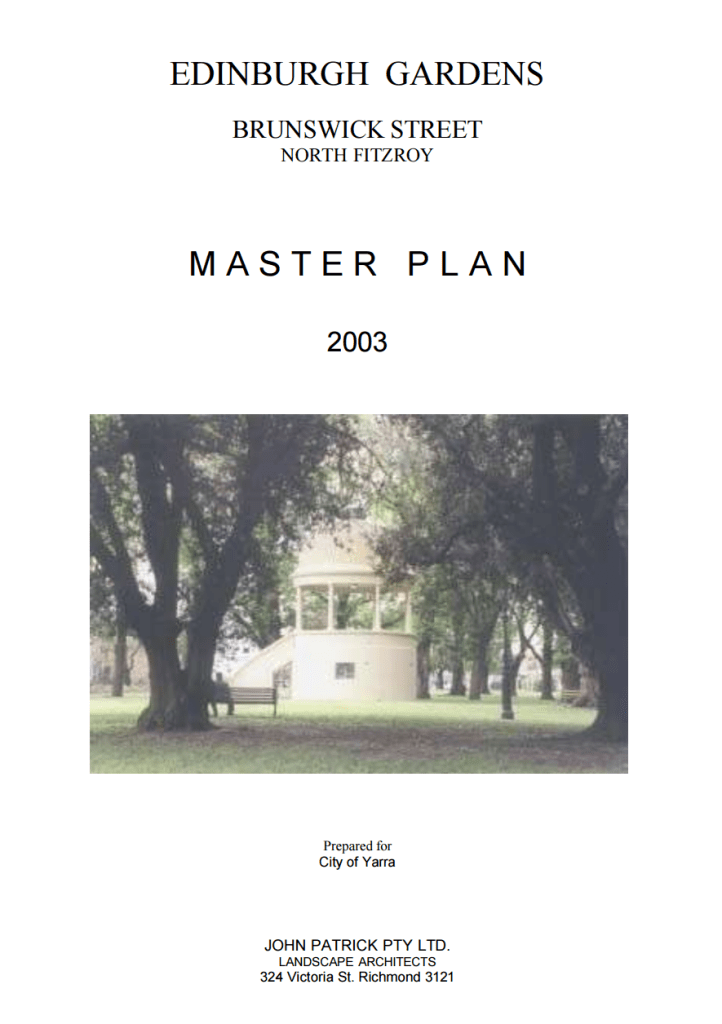
EDINBURGH GARDENS BRUNSWICK STREET NORTH FITZROY M A S T E R P L A N 2003
Prepared for City of Yarra by JOHN PATRICK PTY LTD. LANDSCAPE ARCHITECTS
The original document was published with an encoding that prevents copy, paste or search. The readable document is more accessible, but may have subtle differences to the original.
This Masterplan was never adopted by council. The motion to adopt it was deferred in 2005.
Council Motion to defer adoption of Master Plan (2005)
YARRA CITY COUNCIL ORDINARY MEETING OF COUNCIL MINUTES
held on Tuesday 12 April 2005 at 7.00pm at the Richmond Town Hall
Item 2.4 Edinburgh Gardens Master Plan and Conservation Management Plan
This explains why the 2004 Master Plan was never endorsed. It is also a fascinating window into the City of Yarra’s positions at that time.
Royal Park to Fitzroy Railway Land 1986
Heritage Impact Statement – Brunswick Street Oval Grandstand – Lovell Chen, Jan 2023
This assesses the impact of the proposal on the Grandstand VHR HO751
This report supports removal of the Community Hall.
It describes the process for avoiding any public input the the destruction of the elm avenue.
The report was updated in 2025 (See below)
Urbis Heritage Impact Statement 2025
A Heritage Impact Assessment on the Brunswick Street Oval by Urbis was commissioned in 2023 and updated in July 2025.
This was released at least seven months after multiple community submitters raised concerns at the December 2024 Council meeting about the heritage destruction in the gardens; the significant trees protected by the heritage overlay; and the need for a local heritage impact assessment.
Heritage firm Urbis was engaged to report on the impacts of the project on the VHR listed grandstand. Although the report suggests it will consider local heritage, it does not.
They avoided addressing the destruction of the elm avenue. The closest the report came to acknowledging the issue was in section 7.4 where it said “The proposed siting of the tennis pavilion in this location allows for these updates to occur while also providing for the greater protection of contributory graded fabric including paths and trees within the Edinburgh Gardens than would be allowed if the pavilion was sited to the north outside of the VHR registration.”
It’s not even clear what this statement means, particularly “greater protection”. The Edinburgh Gardens fabric will be destroyed by the location of the additional tennis courts, and not the proximity or distance of the new pavilion to the grandstand.
The Urbis report was focused on the location of the pavilion in relation to the VHR grandstand rather than the critical issue of the location of the new courts and the impact of that on the gardens, as opposed to the grandstand.
Heritage Victoria’s Guidelines for Preparing Heritage Impact Statements in Victoria (June 2021) is published under Section 19(1)(f) of the Heritage Act 2017. It provides guidance that an assessment should at least answer the following key questions in relation to the Edinburgh Gardens Heritage Overlay (HO213).
- Why is the place of cultural heritage significance?
- What options were considered in developing the proposal?
- What impact will the proposed works have on that significance?
- If a negative impact is proposed, why the proposed option was chosen and why were other more sympathetic options were not feasible?
- What measures are proposed to minimise and mitigate negative impacts?
- Why is the proposed approach preferable to alternatives?
The Urbis impact statement did not address any of these questions in relation to the Edinburgh Gardens Heritage Overlay HO213. It did not even correctly identify the overlay, referring to HO231 twice and HO213 not at all.
 The 3068 Group