| REMINDER The 2024 and 2025 AGM of The 3068 Group will be held tonight, Tuesday June 2 at 6.00 pm Google Meet: meet.google.com/gnd-rijp-niw (click this link to join the Meeting online) IMPORTANT Please renew your membership online before the meeting in order to vote |
| If you wish to join, renew your membership online or make a donation to The 3068 Group, please visit: https://the3068group.org/members/ and follow the instructions on the form. |
What’s proposed?
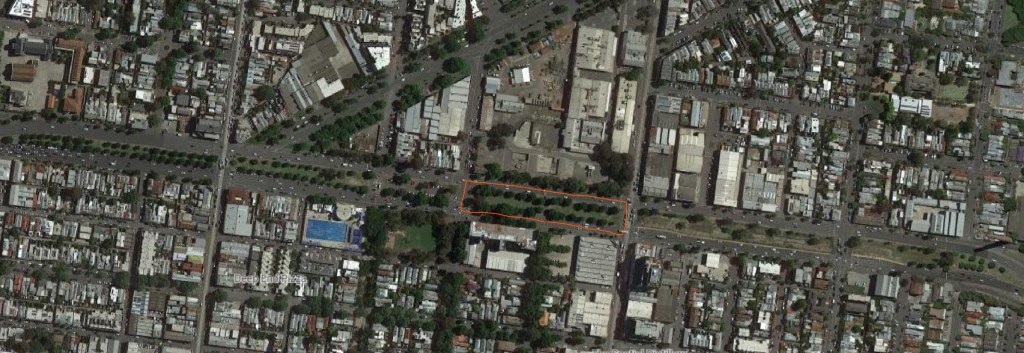
The Developers of the Gas Works plan to convert the green and treed median between the east and west carriageways of Alexandra Parade into a car park for 78 car spaces with slip lanes.
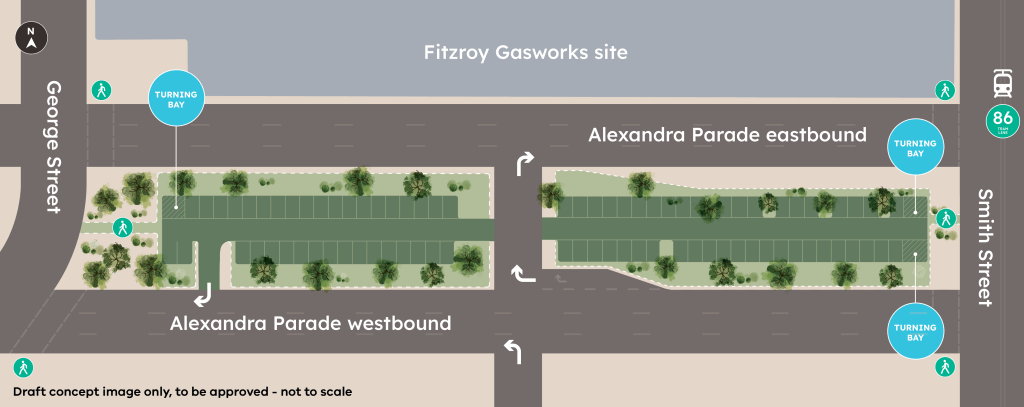
Development Victoria publish a FAQ, but details are lacking
https://www.development.vic.gov.au/projects/fitzroy-gasworks/pages/faq
In May 2024 Council debated and issued a permit to construct the car park. The Agenda has the plans and details.
https://www.yarracity.vic.gov.au/about-us/council-and-committee-meetings/council-meetings/council-meeting-14-may-2024
Where is it?
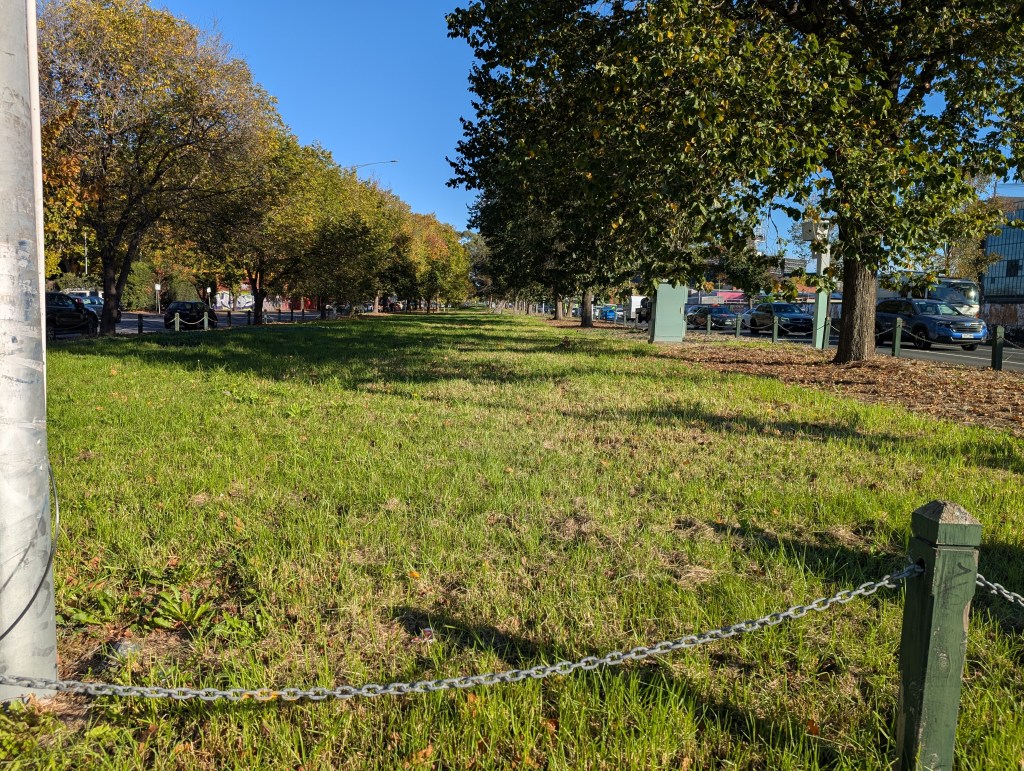
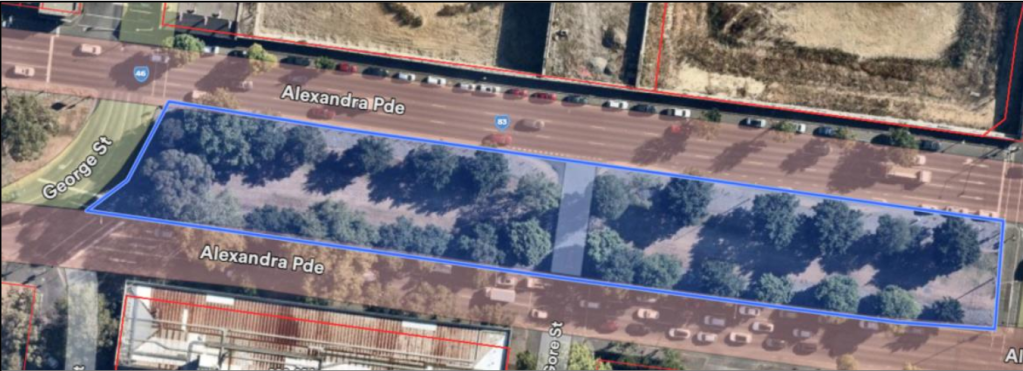
The car park will run from Smith Street to George Street. On the other side of George St the median has been converted to a car park for the Fitzroy Pool. With the new parking, the entire length from Smith St to Napier Street will be car park. The proposed land is 5000sqm which is large enough for eight tennis courts.
What’s the Issue
The car park will reduce green open space in Fitzroy where it is critically low ; remove trees; increase the urban heat island effect; reduce the pollution and noise reduction benefits of the trees; weaken biodiversity; and increase emissions through loss of trees and inducements to drive. It is contrary to multiple policies of the City of Yarra, not least the open space policy and street tree policy.
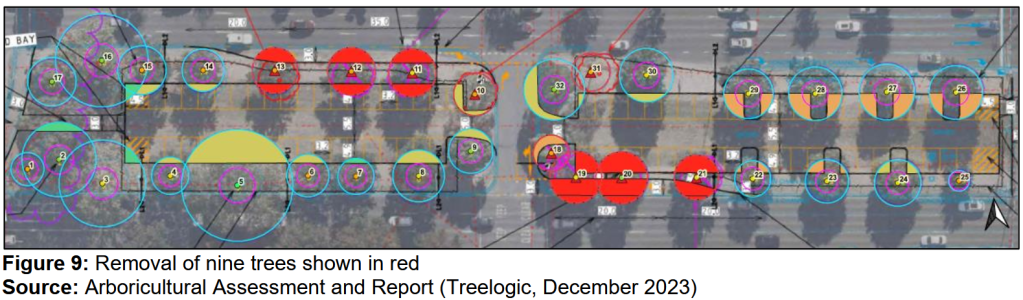
Out of 32 trees, “A Total of 27 trees may be impacted” [Agenda Report May 2024]. 9 trees will be removed, three of which are assessed as poor health. The remaining trees will have encroachments on their Structural Root Zone and or Tree Protection Zone. This includes the ‘moderate rated’ tree 2 (Yellow Box) and the ‘high rated’ 5 (London Plane) maturing tree, which will have six car parks under its canopy.
The developer is Development Victoria. The car park will mostly benefit the corporations developing housing on the former Fitzroy GasWorks. After spending $50m of public funds, the 4ha site has been handed over to the private sector. The off-site car park makes it more attractive to developers. There is a promise of 20% affordable accommodation being developed. Affordable housing tenants are less likely to drive or own cars.
The Department of Transport and Planning manages the land while Council maintains the trees.
Development Victoria held a consultation on the proposal in 2024. The 3068 Group does not support the car park. We wrote to members about this in May 2024 It seems that the consultation had little impact.
Development Victoria kept the results of the consultation secret. A Freedom of Information request by State Member for Richmond Gabrielle de Vietri, recently revealed 78% of responses were against the car park.
What can I do to stop it?
There is a petition to oppose the proposal by the State Member for Richmond Gabrielle de Vietri (Greens).
https://gabrielledevietri.org.au/issue/save-the-alexandra-parade-median-strip/
Cr. Sarah McKenzie (Yarra, ALP) was not a councillor when the permit was considered. She is the ALP candidate for the seat of Richmond at the next election in November 2026. Richmond covers the site.
The Process
Development Victoria is not taking submissions or subject to any formal planning process. They are making use of the secretive planning system that the State Government has been building for a number of years to avoid independent review of planning decisions.
The previous Yarra Council received an officers report on the proposal in May 2024 saying there would “be an
acceptable planning outcome that complies with the relevant Council policies. It is recommended that a planning permit be issued, with conditions.” The report did not refer to Yarra’s Open Space Policy or Wildlife Policy.
The only reason Development Victoria needed a permit is because it is in a flood zone (SBO). A planning permit is not required for the use, or to construct buildings and works or to remove trees.
This means that matters relating to flood impacts and floodplain management was the only consideration in determining whether to issue the planning permit. It also means that the application is exempt from third party notice and review rights and was not able to be put on public notice.
The Council had little choice and a refusal would have been overruled on appeal. The minutes record that Council voted five to four to approve permit PLN23/0819 with conditions. Of the councillors still serving, Cr. Jolly voted for, Crs Crossland and Wade voted against.
Can Mature Trees grow on the reserve?
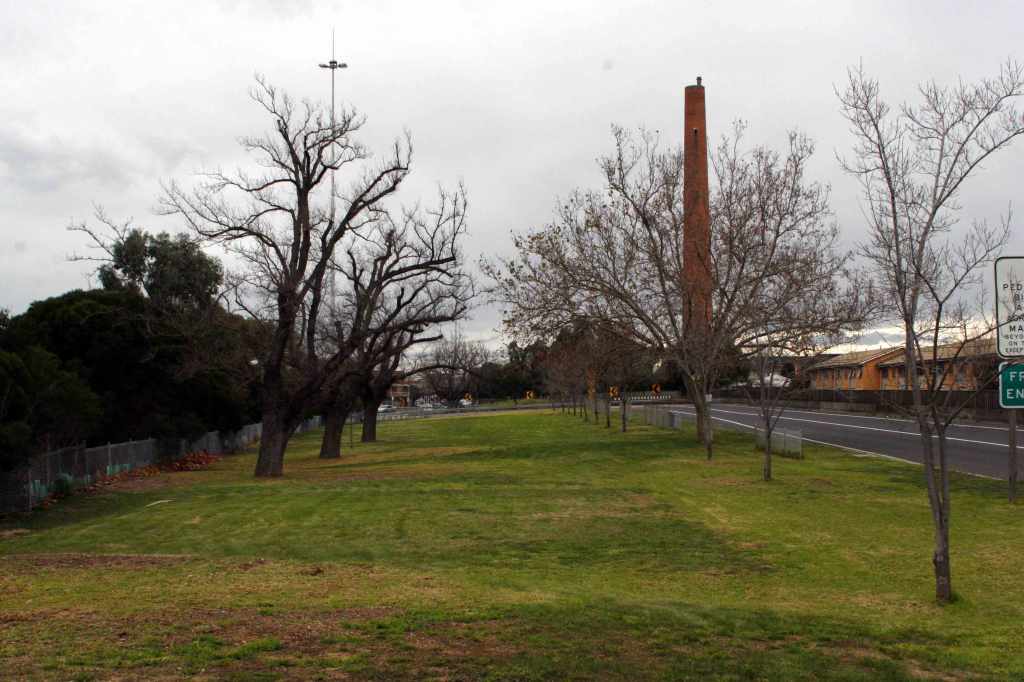
On the green median there are mature trees planted mainly around the edges of the median. These form avenue plantings in some parts of the median. There is a large drain running underneath the reserve which discharges to Merri Creek.
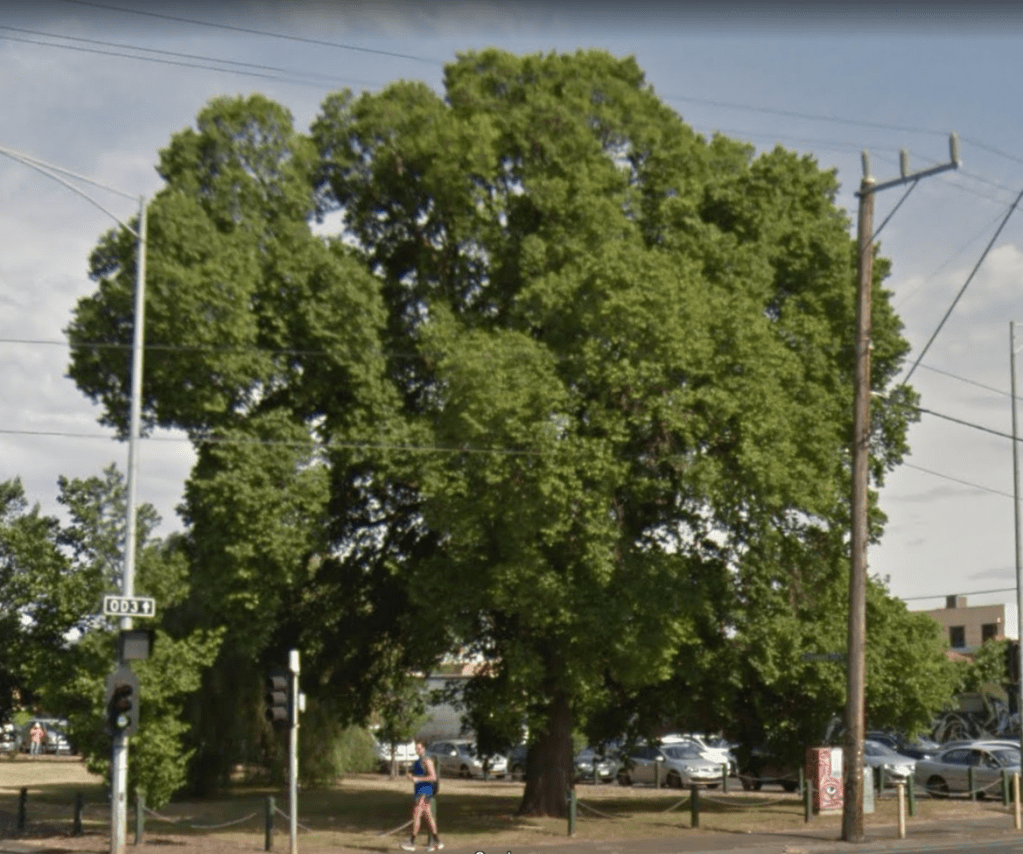
Our post from 2018 shows that very large trees have existed and continue to exist on the reserve, not just at the edges of the median but in the middle, close to the drain. This significant tree was destroyed by a contractor who severed the roots and made it unstable.
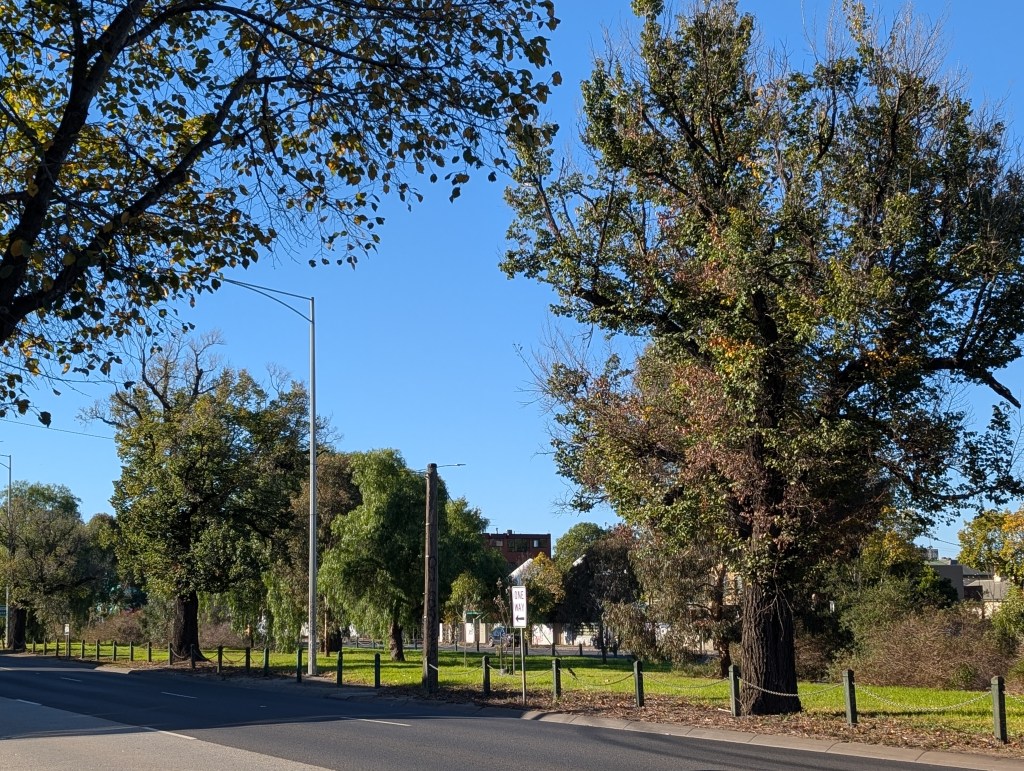
There are more significant trees on the median east of this site.
Parking
The developer says the reason for the parking is for users of the Bundha Sports Centre. This was built on land that was owned by the council and is now privately managed. The sports angle helps to activate vocal supporters and intimidates politicians who feel they need to shore up their sports credentials.
No on site parking was provided despite the massive excavations – the excuse provided was ‘geological’. The business operating model for this centre relies of sports teams from a wide car-dependent catchment to travel here for games. However the modern gym would mainly attract local users. In the evenings, when the sports centre is active, there is parking available at OfficeWorks and many streets have 4-hour parking. There are also opportunities to provide parking in the Gas Works.
There are a further thirty places on Napier Street opposite the triangle park. Napier has only seven houses on one side and some commercial properties. For a driver looking for parking, there will never be enough space close to the destination.
On May 4th after receiving the permit, Development Victoria announced that 150 public car parks would be included in the Parcel B development of the Gas Works.
The Foundry development on the north-east corner of Smith and Alexandra has a permit for 341 spaces – if it goes ahead.
Bundha says there is limited on-street parking on Smith St, Alexandra Pde, George St, and Queens Pde with accessible car spots are located on the Queens Pde Service Road. Collingwood Basketball Association says “Park opposite in the service road on the north side of Queens Parade, or in Smith Street (watch for clearway times), or in Jamieson Street opposite and Alfred Crescent a little further back. Alternatively, although there is no access yet directly from the south side due to ongoing construction works, you could park on or near Alexandra Parade and walk”
The Alexandra Parade car park will be mostly used by occupants of the gas works, the construction crews and shoppers, including the new shops that will be built along Smith St north of Alexandra Parade.
The Heat Island Effect
Converting green medians to hard surfaces and removing trees exacerbates the Urban Heat Island Effect (UHIE). This physical phenomena exacerbates the health effects of heat waves. Urban areas are much warmer than surrounding rural areas, particularly at night. Planting trees and other vegetation and reducing paving are the best ways to reduce the heat increase.
The open pit of the Gas Works, the former industrial areas and the Queens Parade retail strip are 10°C hotter than rural areas (on average up to 2018). This compares with 6°C for Edinburgh Gardens where trees and grass predominate but the buildings and tennis courts add some heating.
The UHIE on Alexandra Parade is more complex because the green median fights with the 6+ lanes of bitumen and heating exhaust fumes. The highest is 10°C near Hoddle St on ramps and the coolest part of the parade is 8.25°C for the area proposed to be converted car park.
The Fitzroy pool is 8.54°C hotter than rural areas on average, so is not working as hard to cool the environment. It has 9 mature trees and extra lanes of lots of bitumen. Interestingly, the median west of the pool carpark is even hotter at 9.25°C despite two rows of mature trees. This may be because the median has been narrowed and the road widened here.
The added heat from the car park will work against the most affordable accommodation in the Gas Works, which will be in the twelve storey towers that back onto Alexandra Parade. As the occupants travel to Fitzroy to access services, they will be exposed to a hotter harder environment.
In Fitzroy, that old elms lining Napier, George and Westgarth St, work together with Smiths Reserve to reduce the heating by a full degree compared to Collingwood.
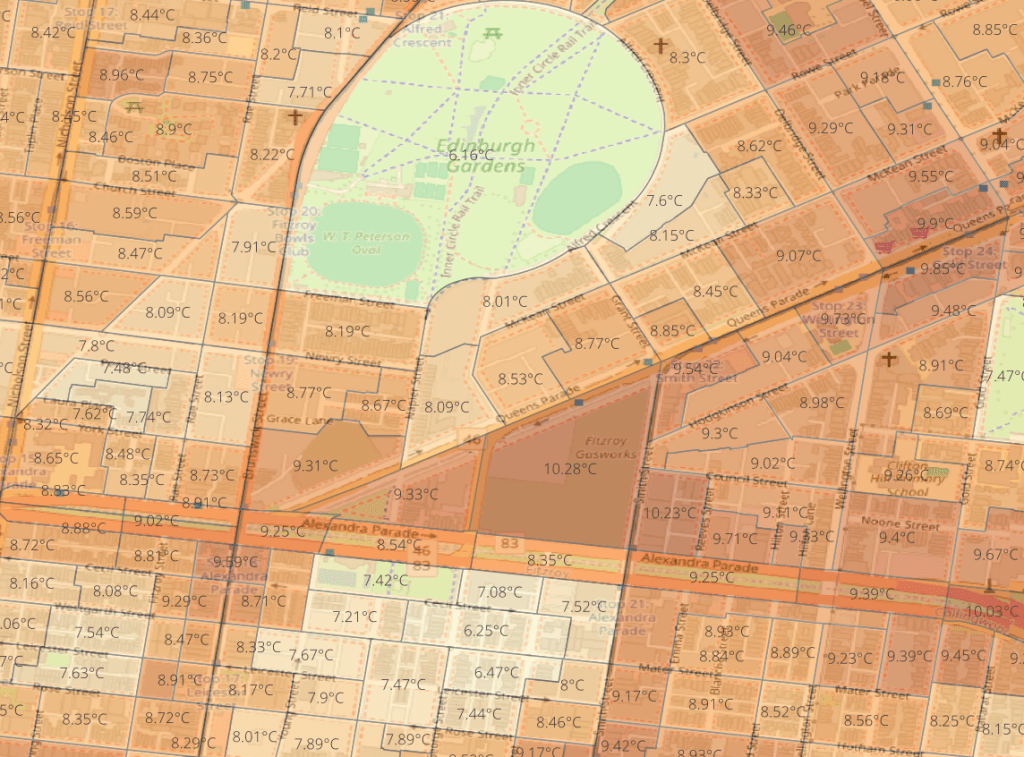
Data from Metropolitan Melbourne Urban Heat Islands and Urban Vegetation 2018, HEAT_URBAN_HEAT_2018
Published 06-07-2019 https://datashare.maps.vic.gov.au/
Trees and greenery can cool cities by as much as 18°C – but only if they’re the right type – Melb Uni. The Conversation, 2026
Ecological Corridors
This is one of the few places in Fitzroy where canopy trees can exist. Most of the trees being planted today will never be canopy trees. Fitzroy is seriously lacking in Open Space and Yarra can’t afford to buy any. The open space left over by the developers of the gas works is tiny.
The median is the largest open space in Fitzroy. The hairy leaves of the trees collect tiny particles of petrol and diesel exhausts.
Exposure to diesel exhaust particulates (DEP) is a recognized risk factor for cardiovascular and respiratory diseases. DEP fine particles cause oxidative stress and systemic inflammation, which lead to heart disease, reduced lung function, and an increased risk of lung cancer.
It is worth researching how the Alexandra Parade median may work as a wildlife corridor for some species. Wildlife corridors are critical for biodiversity. Enhancing the corridors’ connectivity is worth aiming for as it isolated islands of species in reserves are more vulnerable to local extinction. The Alexandra Parade median can connect to Yarra Bend Park which is our best corridor.
Alexandra Parade was established in 1851 as a government road originally named after Melbourne City Councillor Francis Reilly. The parade evolved from a natural swampy watercourse that was formed into a major drain—the Reilly Street Drain—between 1856 and 1858 to drain the surrounding crown land and allow for urban development.
The car park is close to Smiths Paddock (Now Smiths Reserve), a former swamp next to the Fitzroy Pool.
It is also close to the underutilized small triangle park and double row of elms at the beginning of Queens Parade
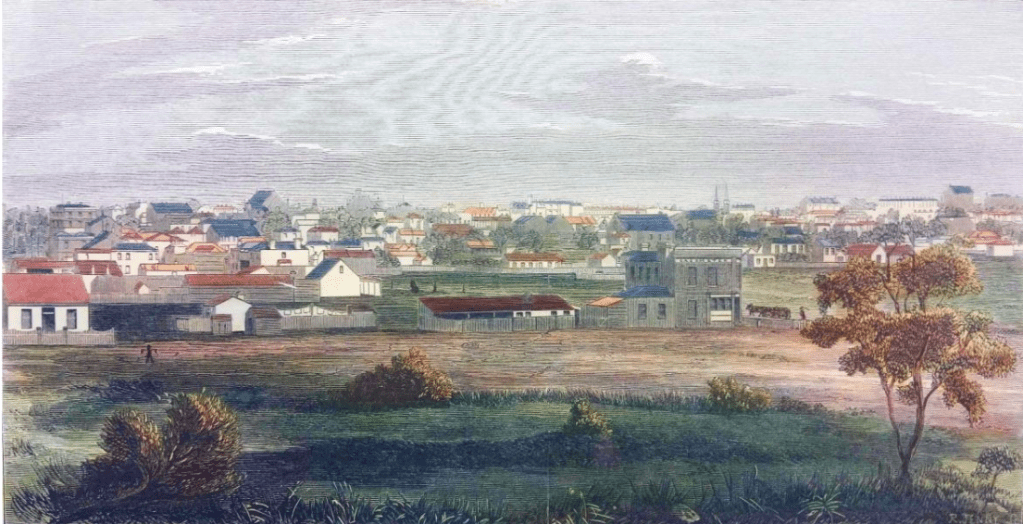
Rudolf Jenny’s etching looking south from Queens Parade (then called Heidelberg Road)
about 1870. Reilly Street in the middle ground with the Gasometer Hotel middle right.
https://collingwoodhs.org.au/wp-content/uploads/2021/11/Collingwood-History-Walk-2021-Notes.pdf
Thinking Big
Once North East Link opens how it change traffic flows on Alexandra Parade? Some vehicles may avoid it in favour of the North East Link, but the link and Eastern Freeway expansion will attract more traffic to the parade. The Big Build indicates a 3% increase in traffic on the parade by 2036 compared to not building the link – similar to Hoddle St.
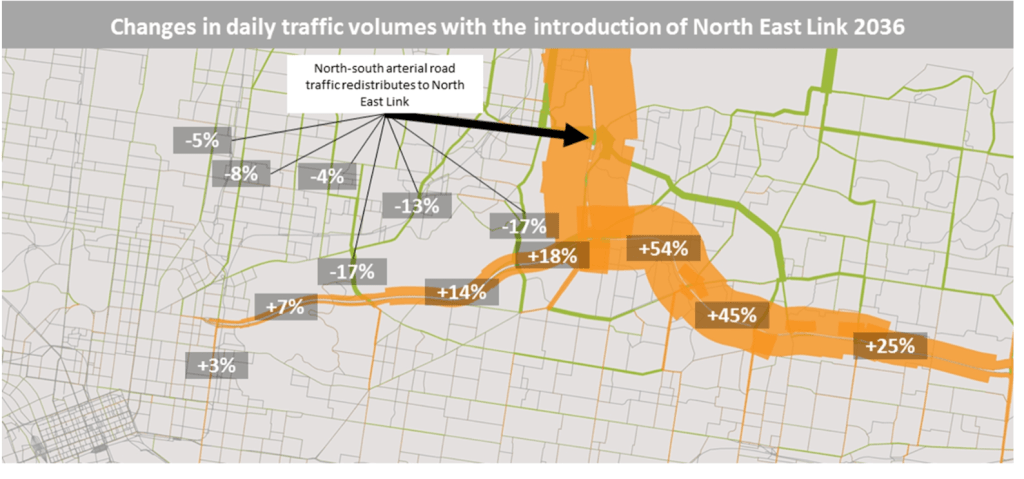
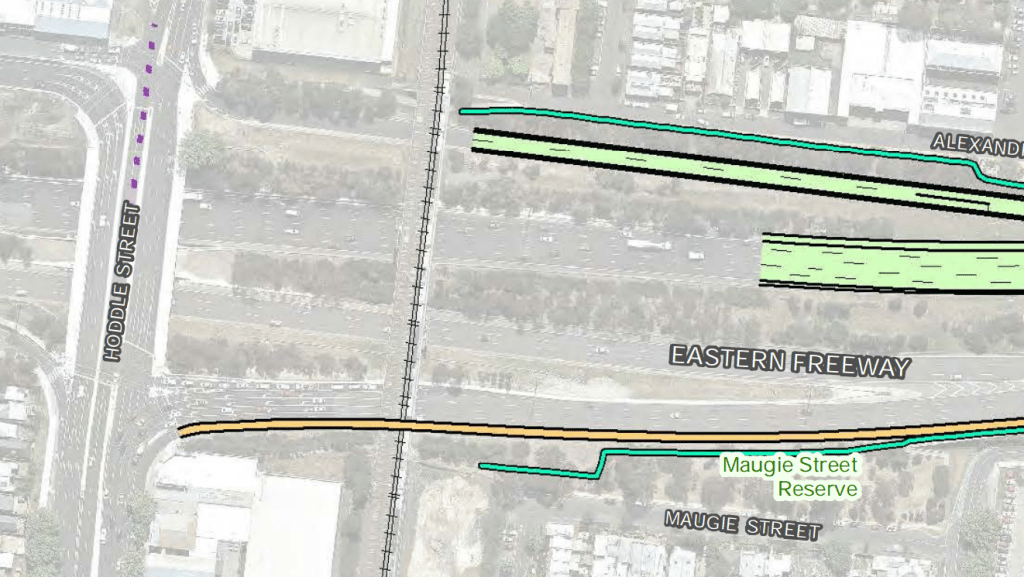
The new busway along the Eastern Freeway won’t be able to service any new bus routes along Alexandra Parade as it diverts to Victoria Park beside Maugie Street Reserve (yellow line below).
A Linear Park
One of the reasons given to not save the green median is that the green space is not easily accessible to people, so is not high quality open space.
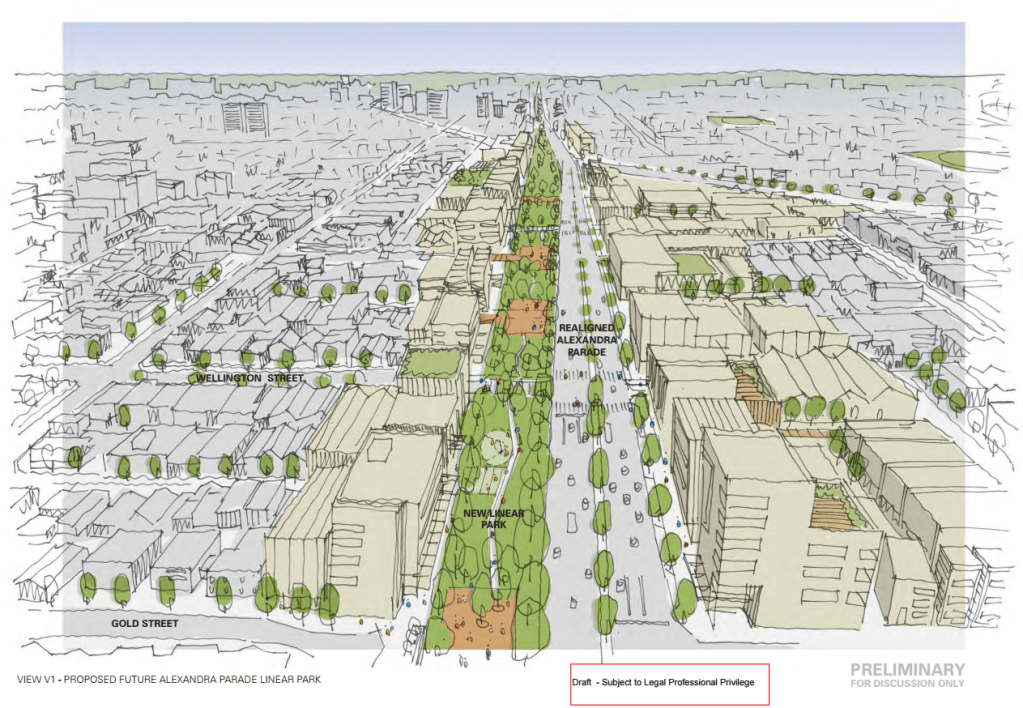
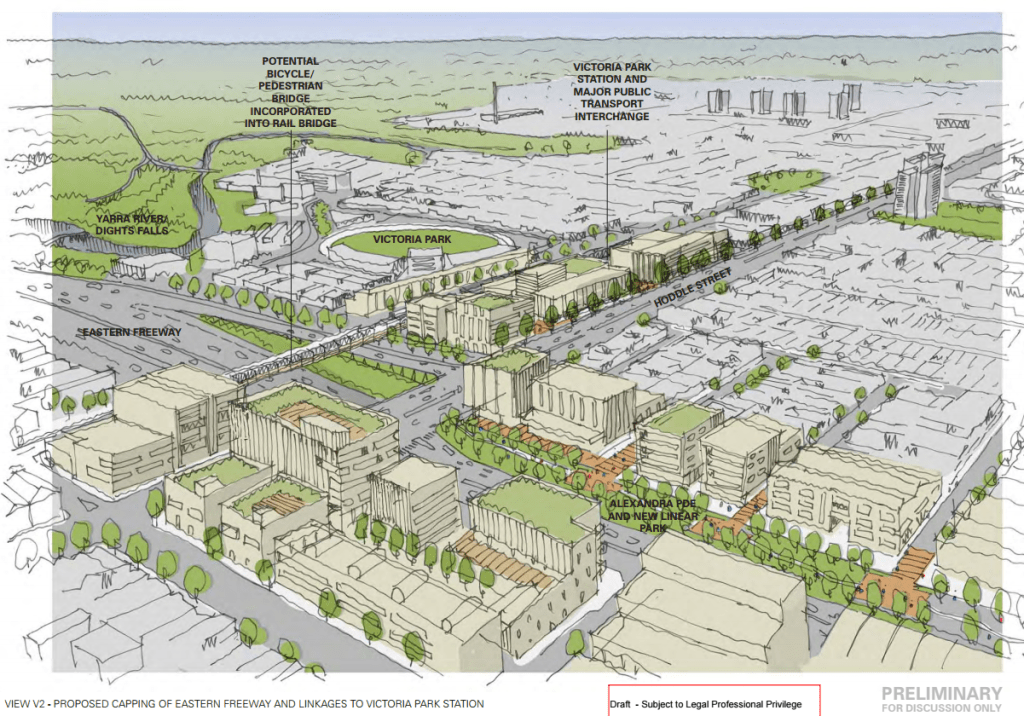
Rob McGauran, an urban design expert, suggested the westbound carriageway be moved next to the eastbound, creating significant open space and a linear park accessible to Collingwood and Fitzroy. It would also make it easier to cross the parade. If sufficient separation with the arterial road was achieved the noise and pollution may be manageable? This is already the case for Smith’s Paddock, a popular local park next to the pool. A linear park would connect from the Fitzroy pool and Smiths paddock to Collingwood.
Noise
Noise Score (as at May 2026)
https://daleads.com.au/map?score=noise#18.2/-37.793861/144.982176/0/50
There are no noise mitigations in place of Smith Reserve or the small triangle reserve that once housed the Isabelle Henderson Kindergarten.