And their Historic Avenue, and their surrounding parkland.
The story so far:
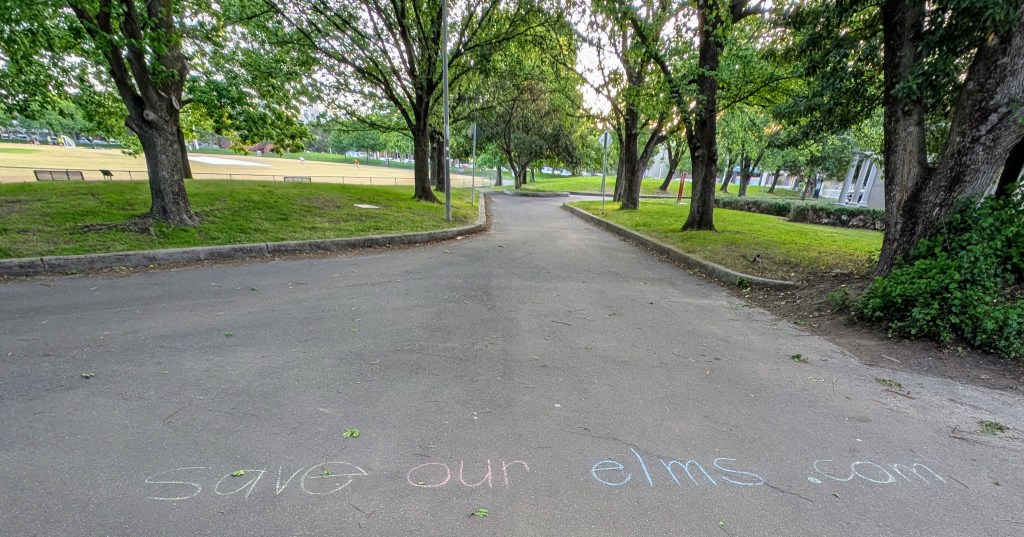
We are not going to let these trees be killed and this Avenue from Brunswick St to Alfred Crescent be lost .
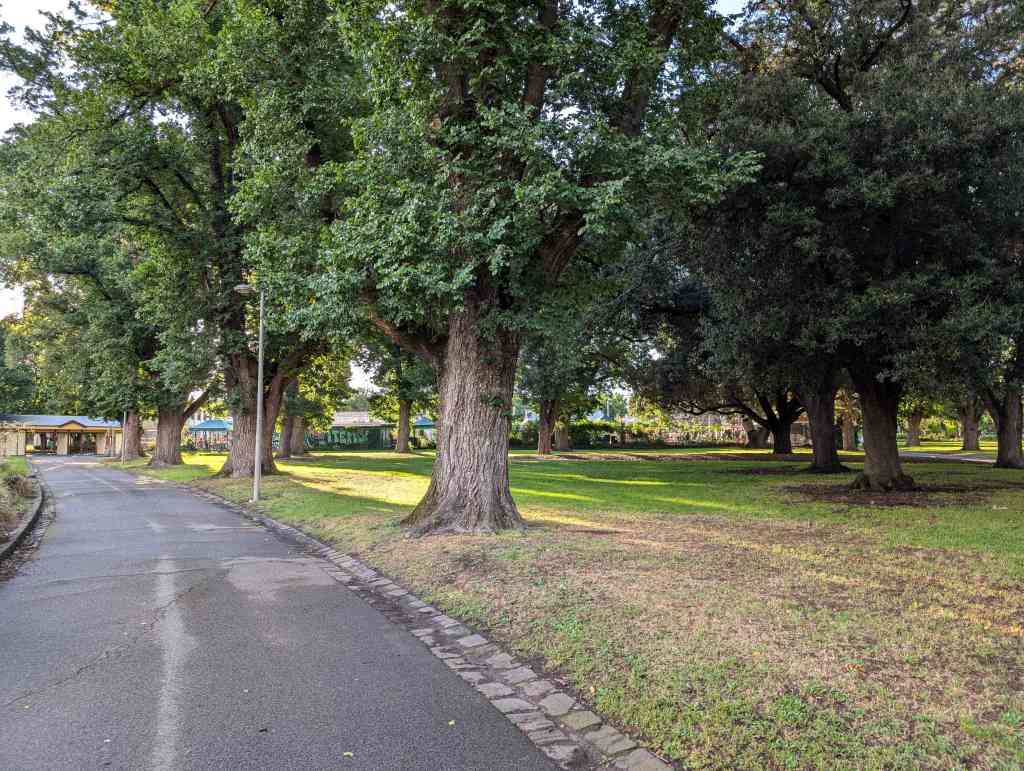
The Brunswick Street Oval redevelopment consultation includes a plan to obliterate this magnificent 19th century elm avenue, of primary significance to the park. They will be “replaced” by a cyclone fence enclosure for two new tennis courts, a massive overdevelopment in the heart of Edinburgh Gardens.
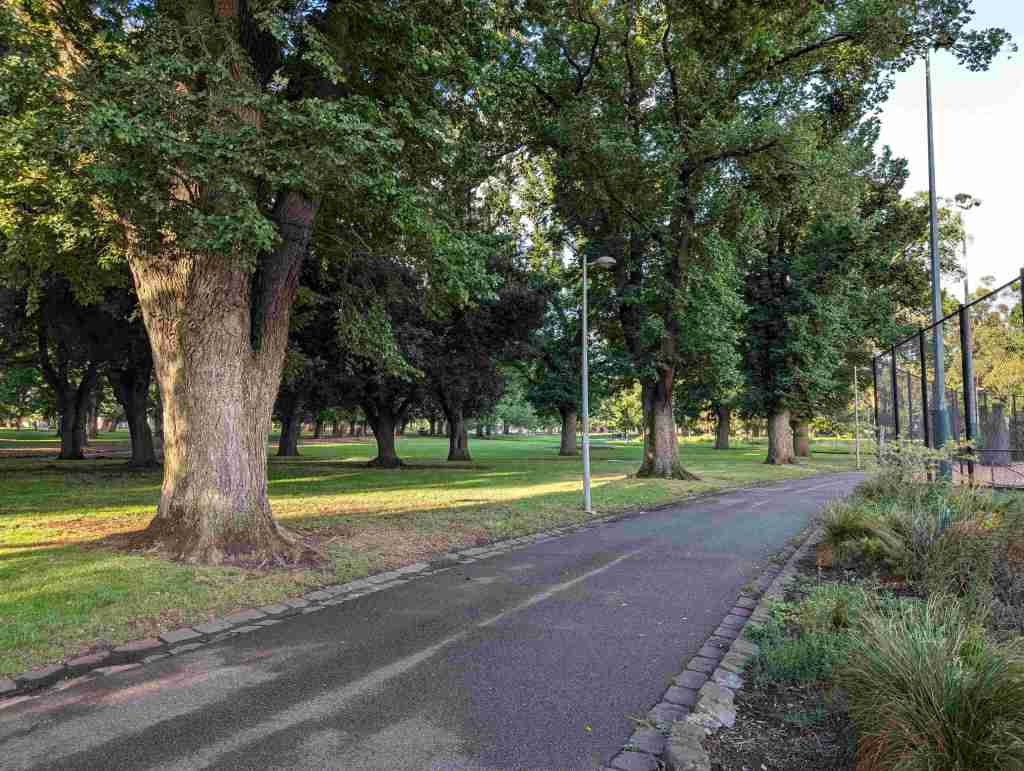
Views like this give the Edinburgh Gardens its much valued character, while the old trees provide habitat in their canopy and hollows. Elms were commonly planted beside tennis courts for the shade, durability and aesthetics.
Removing this historic avenue that links Alfred Crescent with Brunswick Street is unreasonable and unnecessary for the project to succeed. The value of the trees is reflected in these reports.
“Without doubt, the best feature of the Gardens today is the canopy of mature exotic trees that dates in large part from the late nineteenth century. These trees are mostly planted in avenues along the path system of slightly earlier date which links to the surrounding streets and perpetuates the through-passage needs of the pedestrians of that era. Paths and trees provide the basic design and structure of the park [Rex Swanson Landscape Study 1987].
Even if the Tennis Courts are built, they could not be used. Yarra does not have the legal right to lease that land to the Tennis Club or anyone else. The right to lease the land south of the avenue and the bowling club(s) is permitted by the Edinburgh Gardens Lands Act 1967. The legislation prohibits Council from leasing the Crown land outside the existing sports area. There is no publicly announced plan to amend the legislation to support this project.
No scaled plans were made available for this consultation. Imagine applying for a permit without a scaled plan. Nowhere is removal of the path mentioned.
The City of Yarra tick the box consultation has the demeaning title “Your Say“, (abbreviated from Have your say). The flawed consultation is now closed. It did not include any links to Council minutes or reports or heritage referrals, just a potted list of what’s changed. The consultation did not include any reference to an expensive 2021 Conservation Management Plan by Lovell Chen. The council has not published this deeply conflicted study which seeks to downgrade the heritage significance of the elm avenues. The study was prepared after Lovell Chen had already proposed tennis courts to replace the elm avenue. No wonder they don’t publish it.
Yarra Council was tricked into accepting the location for the new grandstand by planning officers who told council it would cost $1.5 million in design changes and a six month delay to place the grand stand where the old grandstand stood until 1977. Yarra council, scared of losing State Government funding, and with a coalition of sporting interests in the chamber, did not question the veracity of this extraordinary claim and approved the new pavilion towering over Brunswick Street and the Oval.
Tree Replacement Plan
Justifying the destruction of mature canopy trees by offing to replace them with the same number of saplings does not stack up. It will take a century.
Yarra boasts about the trees it is planting, but rarely mentions the trees that are destroyed. Trees close to new buildings will be impacted. Every new development in Yarra reduces the space for trees.
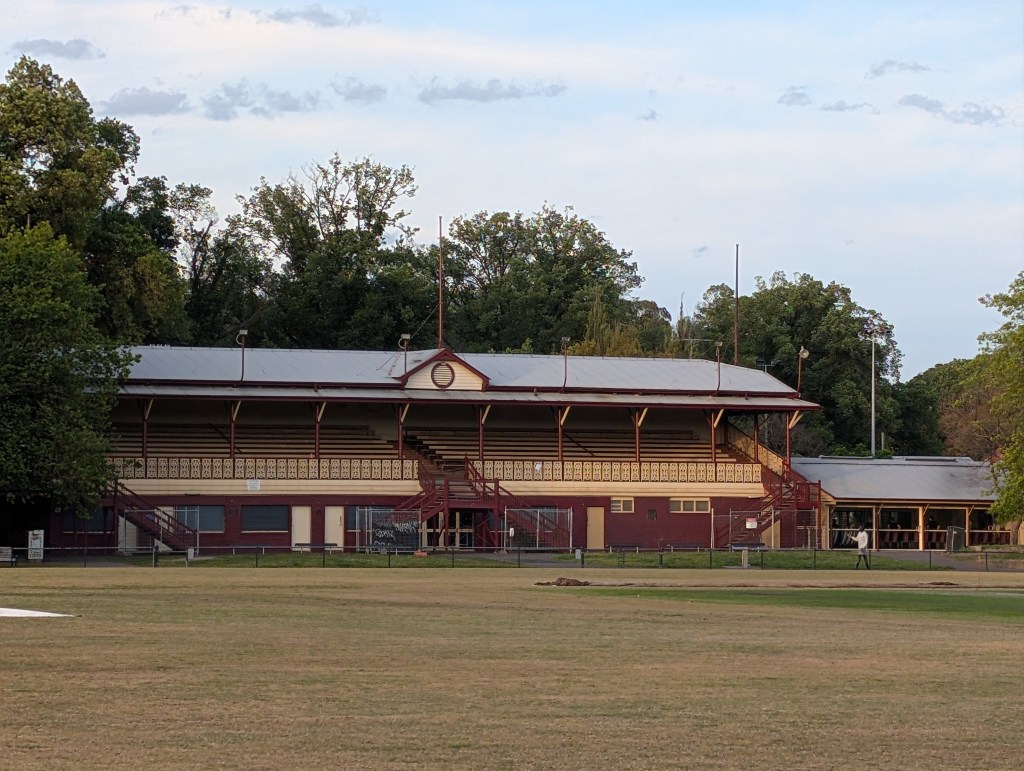
The 1888 timber grandstand is backgrounded by a row of beautiful elms that create a garden setting. This act of destruction will impair this view
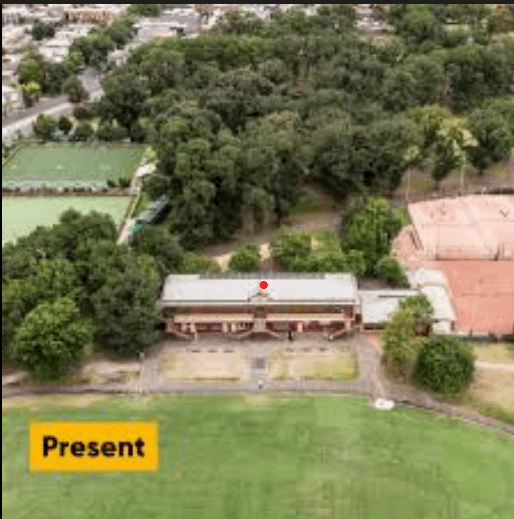
The Grandstand is set in front of a row of elm. Three are proposed to be cut down. The largest tree on the left of the image, one of the biggest in Edinburgh Gardens, will have its roots cut and soil impacted. It will suffer.
An precious Urban Forest in the heart of Edinburgh Gardens
“I am always concerned about the unnecessary removal of any mature trees. We have insufficient urban trees as it is and the loss of mature trees is a significant issue across Victoria.
I also have major concerns about mature tree replacement. One for one replacement does not come even close to providing adequate compensation for the loss.
The alienation or greenspace and the loss of parkland to hard structure, parking and other facilities is a major problem as climate changes and the urban heat island effect (UHIE) increases. I am very worried about heatwave related illnesses and deaths in Victoria during a future heatwave.
More than most, I understand the need for recreational facilities, but I am opposed to the use of existing facilities for these purposes. I advocate for the purchase/acquisition of new space for these facilities and have a strong view that this is too big an issue for local government and that State government should take the lead..”
Dr. Greg Moore OAM, responding to the Edinburgh Gardens redevelopment, Nov 22, 2024
Call to Action
What can I do?
Can the destruction be stopped? Only if the new council or the State Government stops this senseless destruction. They will only do that if they hear from you.
Write to them. Share this post among friends and local groups. Your local network covers many people that the 3068 groups network doesn’t reach.
Write to the Mayor and Councilors with your thought about this. Especially your ward Councilor.
The Brunswick Street Oval redevelopment consultation includes a plan to obliterate this magnificent 19th century elm avenue, of primary significance to the park. They will be “replaced” by a cyclone fence enclosure for two new tennis courts, a massive overdevelopment in the heart of Edinburgh Gardens.
Views like this give the Edinburgh Gardens its much valued character, while the old trees provide habitat in their canopy and hollows. Elms were commonly planted beside tennis courts for the shade, durability and aesthetics.
Removing this avenue is unreasonable and unnecessary for the project to succeed. The value of the trees is reflected in these reports.
“Without doubt, the best feature of the Gardens today is the canopy of mature exotic trees that dates in large part from the late nineteenth century. These trees are mostly planted in avenues along the path system of slightly earlier date which links to the surrounding streets and perpetuates the through-passage needs of the pedestrians of that era. Paths and trees provide the basic design and structure of the park [Rex Swanson Landscape Study 1987]
Its not the first time a sports club has tried to destroy an elm avenue.
“The extension of the cricket ground in 1934 brought about the most substantial change to the Gardens of this inter-War period. The Fitzroy Cricket Club had first proposed to extend the ground by 30 feet (9.1 m) in 1926. In doing so, an avenue of elm trees was to be removed. The proposal drew much opposition from local residents and was described by the press of the day as ‘as a gross act of vandalism’ and a ‘typical instance of the methods adopted by interested parties in flinching portions of the public estate’.” [Fiddian, M. Trains, Tracks, Travelers: A History of the Victorian Railways, South Eastern Independent Newspapers, Pakenham, 1997. reproduced in the Conservation Management Plan 2004]
The Elms, and the path they line, date back to at the late 1880’s, The paths were possibly constructed in response to the residents petition of 1887. The petition of citizens asks for removal of certain fences erected by the Committee of Management which impede free access across the northern ground. The petition also asks ‘… that paths should be made from one gate to another for the accommodation of pedestrians’ and notes that ‘… paths already worn by the feet of pedestrians…’ [Swanson 1987]
“Maps show that within the next few years this part of the Gardens north and east of the bowling green was developed with paths and trees.” [Swanson 1987]. The paths are also shown in MMBW plans from 1896 and 1900.
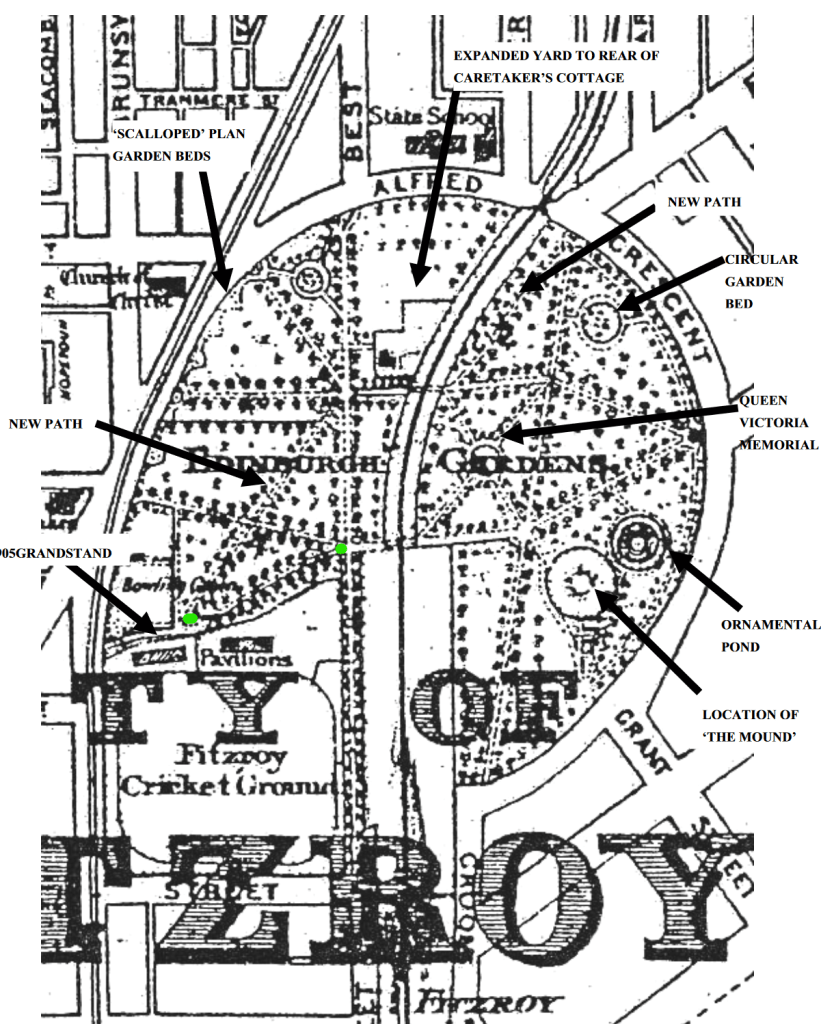
A portion of an unidentified map of the northern suburbs, circa 1905. Reproduced in Swanson Landscape Study 1987, pg 58. The elm avenues are a main feature. Green dots identify the ends of the avenue to be removed.
The elm avenue
While there has been much contention about the location of the new grandstand, the destruction of this landscape of primary significance to the gardens was hard to discern from the Your Say public consultation documents.
No scaled plans were made available for this consultation. Imagine applying for a permit without a scaled plan. Nowhere is removal of the path mentioned.
The City of Yarra tick the box consultation has the demeaning title “Your Say“, abbreviated from Have you say. It is now closed. It did not include any links to Council minutes or reports or heritage referrals, just a potted list of what’s changed. Nor did it mention that Yarra had already been forced into accepting the location for the new grandstand by planning officers who told council it would cost $1.5 million in design changes and a six month delay to place the grandstand where the old grandstand stood until 1977, which is incredulous. Yarra council, scared of losing State Government funding, and with a coalition of sporting interests in the chamber, did not question the veracity of this extraordinary claim and approved the new football pavilion on Brunswick Road, blocking many views of the historic grandstand and oval from the road.
The purpose of the consultation was only to garner support from organized groups. The officers will present a report with statistics to the new council – any heritage or environmental concerns, will be abbreviated to “heritage”, “environment”, duly counted so as not the trouble the councilors with the actual issues raised.
Tree Replacement Plan
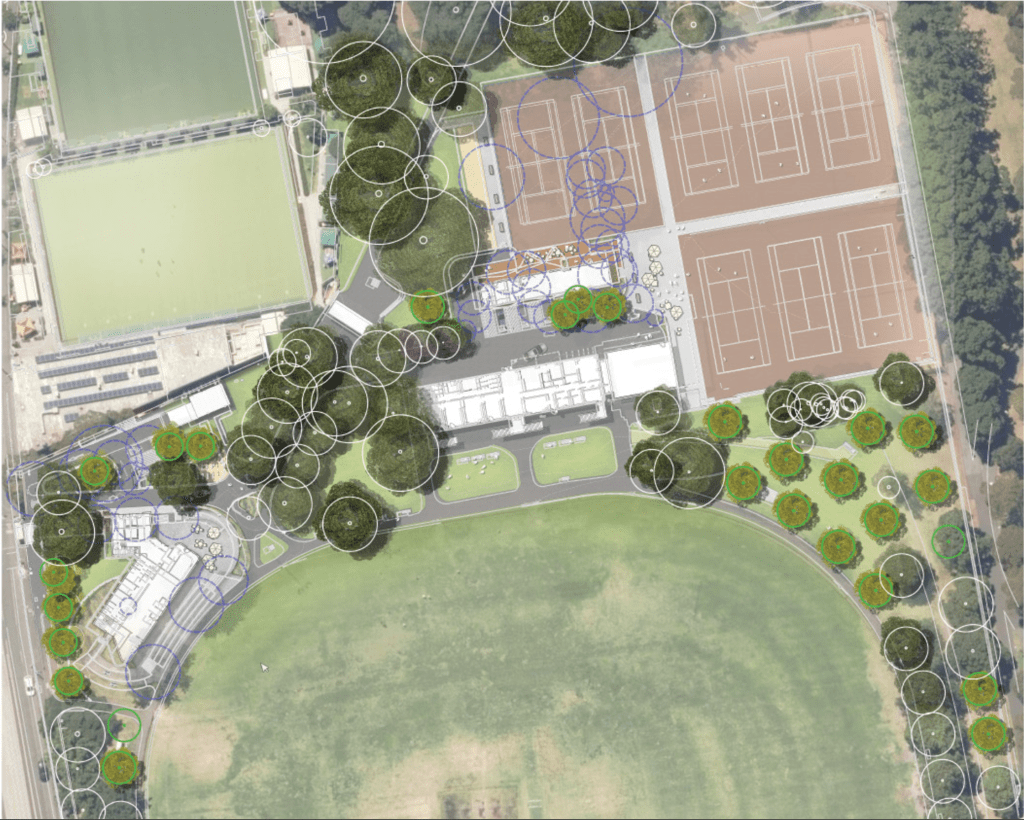
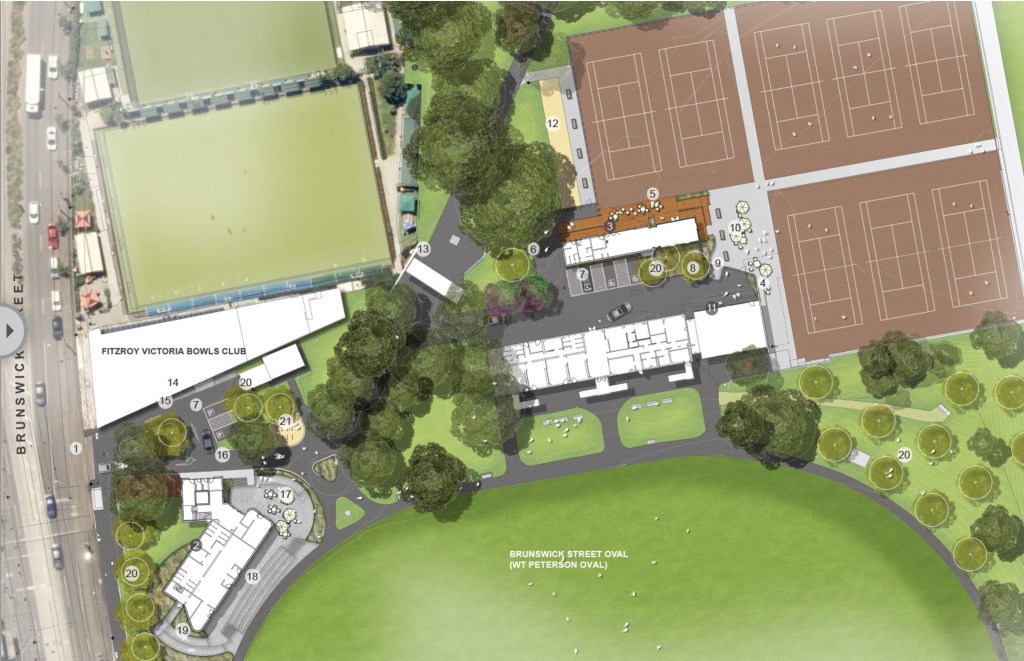
Readers of the Your Say site may be able to click through to the “Tree Replacement Plan” where they will find faint blue dashed circles that mark the trees to be executed, with the following legend:
Blue dashed circles – 39 existing trees proposed for removal including:
8 Low retention value trees
5 Medium to Low retention value trees
9 Medium retention value trees
15 Medium to High retention value trees
2 High retention value trees
Please note: Retention value of trees is assessed based on whether the tree is native as well as the tree’s height, health and significance
The plan doesn’t even show which trees are high retention, or that three or four of the trees are part of an elm avenue of primary significance to Edinburgh Gardens. The 3068 Group asked for this information when the consultation was open and was eventually provided with the this same plan provided in the consultation. It dodges answering the question.
These tree’s retention value was devalued because they are not native! Does significance refer to heritage significance or something else? Where is the assessment published? What was the methodology? Why did no one speak out – in particular the well remunerated heritage consultants who should be protecting heritage?
The trees to be removed are not shown as trees but as empty blue circles on the tennis court.
Tree Replacement Plan
The removal of 39 trees is euphemistically called tree replacement. Trees take decades or in this case centuries to grow. Yarra is spending its limited budget planting as many trees as it can, wherever it can as part of its Urban Forest Strategy. Many of the new trees die in the first few years. Additional climate emergency funding has accelerated our street tree planting program. This is one of many actions that Yarra is taking to address the climate emergency. Politicians always trumpet tree planting, with photos and busy-work for kids and community. But when the saplings fail, as they often do, no one is around to record the event and make adjustments.
Mature canopy trees are particularly important. For shade and shelter for people; for reducing the Urban Heat Island Effect; for sequestering carbon, particulate matter and other air pollutants; for reducing the severity of localized flooding by intercepting stormwater; for connecting biodiverse locations and provide localized biodiversity.
This ‘tree replacement program’ is not replacing the old trees, those trees will never be replaced. The new trees are ones that Yarra could plant today without destroying the habitat, landscape and cultural heritage of Edinburgh Gardens. Calling it tree replacement is a financial artifice, like a biodiversity offset.
Was any heritage advice sought on this? Retaining primary significance fabric is the first principal of the heritage conservation. The main heritage consultant is Lovell Chen, whose main business model is to facilitate their clients’ developments. If they gave Yarra advice on the pros and cons of the removal of the elm avenue it has not been made part of the consultation.
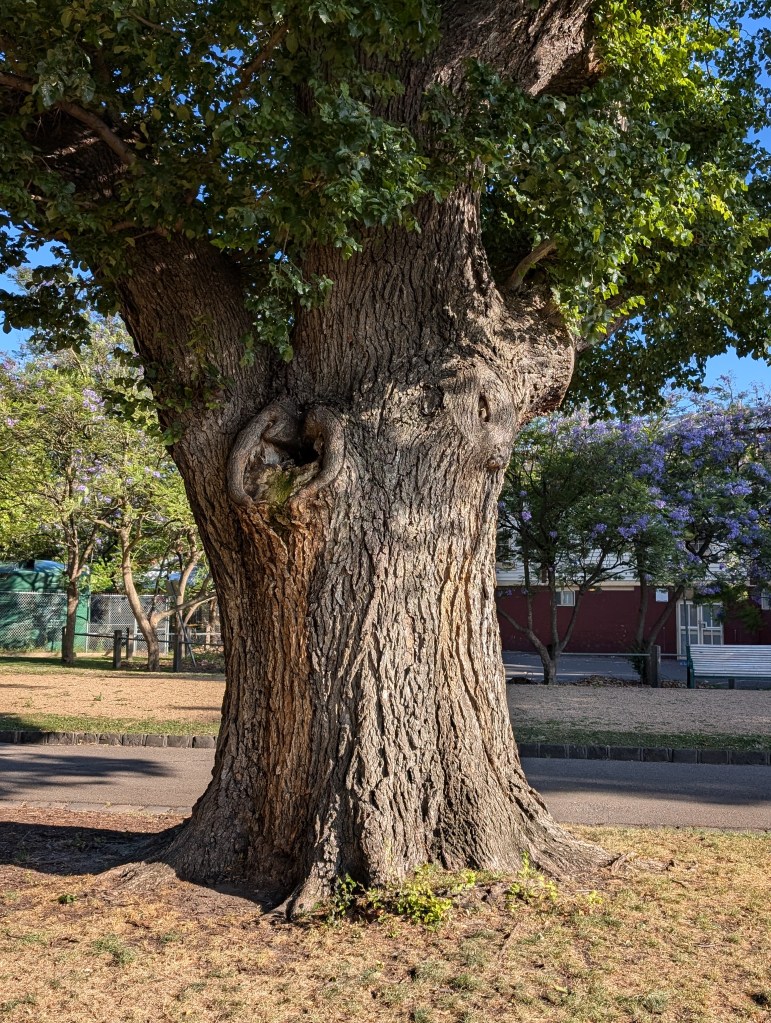
The avenue tree closest to the gate house is shown with the largest of the white circles. We are to infer that it won’t be felled. It has a massive trunk with large holes where branches fell long ago. The plan shows new buildings under the drip line on two sides of this old tree, which already has hard path surfaces to content with. When roots of old trees are cut, the trees die. Impacting the soil is another effective way to destroy a tree. Not immediately, but the life expectancy is shortened. Dieback starts from the crown. It may become unstable and have to be removed to protect the underlying assets and the public. There are 400 year old elms in Europe. The trees on this avenue are not senescent. With care they will be there for future generations. This tree needs better care and attention, no chainsaws.
Dutch Elm Disease
Around 1967, a highly contagious and lethal strain of Dutch Elm Disease arrived in Britain. More than 25 million trees died in the United Kingdom while France lost 97% of its elms. By 1990, very few mature elms were left in Britain or much of continental Europe. The disease also spread to the US. There are few mature elms except in a few isolate areas like the Isle of Man. Elm was the most common tree in Paris from the 17th century; before the 1970s there were some 30,000 ormes parisiens. Today, only 1,000 mature elms survive in the city.
The path proposed to be removed is a main east-west link from Rowe Street, through the ticket pavilion to the proposed sports pavilion and St Georges Road. The paths take routes which ‘clearly reflect the practical, through traffic needs of pedestrians rather than a garden designers aesthetic predilections’ [Edinburgh Gardens Landscape Study, Rex Swanson, Landform, 1987]
The Conservation Management Plan for the gardens explains why the path is so wide.
“Common to parks and gardens of the period, regulations drafted in 1883 required that ‘persons visiting or walking through the [Edinburgh] Gardens shall keep to the footpath’. This notice was accompanied by a warning that ‘… no person shall lie on the seats or on the grass’.55 Wide paths were therefore required and those in the Edinburgh Gardens were up to 14 feet in width (4.3 metres).
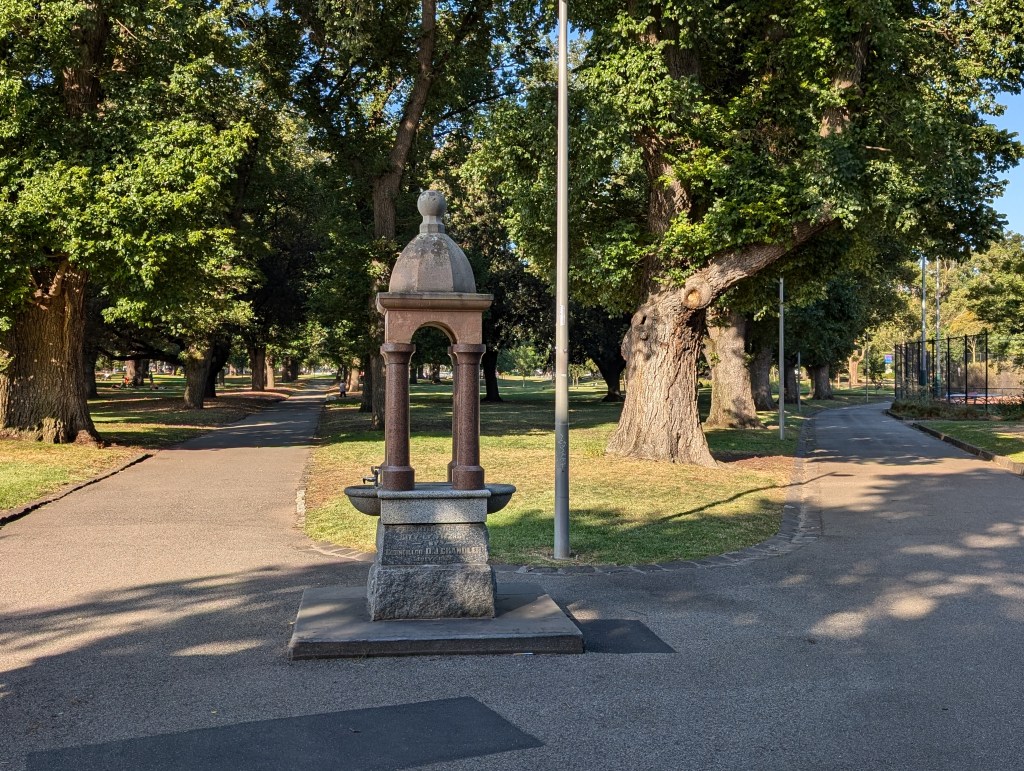
There is no plan to replace the path. A stump of the path will be retained where it is amputated. Presumably the stump will provide a setting for the 1926 Chandler memorial drinking fountain. The existing 1880’s path is barely legible on the plan as a white dotted line. This would help draw away attention from the destruction so as not to garner too many negative comments.
Landscape of diverging elm avenues to be destroyed
What can I do? Call to Action Can the destruction be stopped?
Only if the new council votes to stop this senseless destruction on Tuesday. They will only do that if you write to them today or before Monday. Share this email. Your local network covers many people that the 3068 groups network doesn’t reach.
Write to the Councillors with your thought about this, and do it before the weekend is over. Especially your ward Councillor.
Sharon.Harrison@yarracity.vic.gov.au Evangeline.Aston@yarracity.vic.gov.au Meca.Ho@yarracity.vic.gov.au Andrew.Davies@yarracity.vic.gov.au Sarah.McKenzie@yarracity.vic.gov.au Sophie.Wade@yarracity.vic.gov.au Kenneth.Gomez@yarracity.vic.gov.au Stephen.Jolly@yarracity.vic.gov.au Edward.Crossland@yarracity.vic.gov.auThere is no petition to sign, that is playing the futile numbers game the officers have already stitched up as part of the fake consultation. Its not numbers but thoughtful responses to the councillors directly that may have some influence.
What’s the process?Many Councillors are new and may not be aware how manipulative their administration is.
The officers say “The project stakeholders are supportive of the proposed design” You are a stakeholder. As a resident, you are paying for this. Are you supportive or would you prefer changes to reduce the scope and bring the project back within budget?
The officers say any changes “would further compromise Council’s relationships with key sporting stakeholders and government agencies supporting Council to deliver the project” Who exactly does council have a compromised relationship with? This barefaced statement is in the report for Tuesday’s council meeting named public agenda version1. Is there also private agenda?
Officers are trying to anchor the council into a belief that all the decisions have been made and it is a fait accompli and they just have to raise another $2.4 million of residents.
The State department of planning (DTP) has advised that only an amended planning approval (and not a new planning application) will be required. The planning approval included the removal of a number of trees and the new design has no additional trees to be removed and 10 fewer trees proposed for removal as compared to the approved design.
“The trees nominated to be removed vary in size, species and significance. The trees to be removed include three significant English Elm trees being of medium to high retention value located to the north and west of the existing tennis courts, to enable the expansion of the tennis club area.”
How do these trees get to be of medium to high retention when the plans blue circles show high retention? The officers are even arguing that the new plan removes fewer trees than the previous plan. They say “In the development of the revised design, a key objective has been that no additional trees are to be proposed for removal, with a reduction in numbers removed where possible.” But all the other trees behind the grandstand are immature, insignificant and replaceable. It should not be and never really was a key objective. Retaining primary significance should be an objective. Sadly Yarra’s heritage consultant lacked the values needed to say no. The heritage firm also supported the previous glassed-in grand stand design that was ultimately rejected by Heritage Victoria, wasting several years and millions of dollars.
For heritage permits as with planning permits, the officers are anchoring the council to believe they have no power to review or change these decisions. Heritage Victoria can stop the project if it impacts the grand stand, but has no control over the elms. The elms can be removed by council issuing a permit.
There is no realistic avenue for appeal if council approves the destruction.
Although an affected party can in theory challenge the decision at VCAT, both the Victorian Government and the City of Yarra has been assiduously making it harder to objectors to influence planning decisions. It would be difficult to fight them both with so much pride and finance on the line and of course the clubs will be invited to join the pile on. The council won’t spend resources defending heritage but they will hire lawyers and consultants to defend this. The lawyers always win and the community has to pay the bills.
The officers have scheduled the tree removal as the first action under early works. Even before a final architect is decided. They are ready with the chainsaws as soon as council green lights the destruction.
Without a loud and vigilant community supporting councilors the tennis club will get their grand ambit design and the officers get a big project on their resume. The ratepayers are left with the funding shortfalls. We will be left arguing over who gets to fashion the timber into furniture. The grandstand will be left in its decrepit state, disfigured by glass entrance boxes.
Many people and even some community groups are afraid of speaking out against the clubs. People don’t like confrontation.
The 3068 Group has been fighting for the gardens since 1998. We helped prevent the library in the gardens (a worthy project that was in the wrong place). Moving the library to Best street allowed the Gardner’s cream brick house to be removed from the gardens and the Emily Baker Infant Welfare Centre is now redundant and can be removed as the library now includes the infant welfare centre.
The Fitzroy Tennis club only ever had space for 6 courts in Edinburgh Gardens. Converting the community room to a tennis court impacts views of the grandstand. Moving the new courts east destroys a row of mature non-heritage elms and exposes the cyclone fenced enclosure to the ovals to the east. Moving north will destroy this elm avenue forever.
Every evening this week, when the weather has been fine, there have been vacant courts.
The two new courts are for the pros. The new courts are to be a hard surface which is preferred by more advanced competitive players. The softer surfaces are better for kids and learners as they causes fewer injuries. There is already a world class tennis centre that sprawls across Melbourne Park. It is easily reached from anywhere in Yarra. It has the best tennis facilities in the world. Competitive players don’t need Edinburgh Gardens.
Upgrading the six courts and club house of the Fitzroy Tennis Club is not an issue. The benefits of the extra courts don’t outweigh the very considerable costs. Even on Saturday morning there are many vacancies.
Removing two courts from the plan and retaining the trees and path would assist council to address the budget shortfall of $2.4million. Instead, “The proposed works to the grandstand have been scaled back to match the available budget”. Heritage is the lowest priority for this project and the first thing the project will compromise.
Is this destruction necessary?
There are six existing courts, refurbished and upgraded in 2007, 3 En-Tout-Cas courts and 3 Synthetic Clay [Lovell Chen 2019].
The north-west tennis court is already shifted further south than the other two northern most courts. The setup forgoes the caged alley between the north and south courts to save a couple of meters and not encroach onto the path. Clay tennis courts can be porous, especially if combined with flexible pavement [TA]. The tennis club has asked for some of the courts to be synthetic. Hopefully the replacement surface has a porous surface and substrate for courts close to the trees. This also reduces runoff which is a serious problem for the gardens. There would likely be roots underneath the existing courts. The trees are in good health but may suffer root damage from excavations within their drip line.
Adding two more courts will crowd the generous new tennis pavilion and its obligatory car parking in the park. Can tennis club and football club users share parking?
Are eight courts needed in Edinburgh Gardens?
The existing courts are only fully booked a few hours each week. For next week, the first week of December, the courts were all booked for “music on the courts’ from 2 to 5pm. The Saturday morning is fully booked for “competition” until 1pm, but almost completely vacant from 1pm. Mondays and Fridays are the busiest week days, but the calendar has plenty of vacancies, particularly from mid morning to early afternoon every day, and is usually completely vacant from 8pm.
Where all 6 courts are booked, it is often because 3 courts are reserved for coaching. Shifting the coaching to less popular times, staggering it or moving to the new indoor sports centre would free up this capacity.
Anyone who wants to play tennis in Edinburgh Gardens can already do so unless they require a slot during these busy periods or they want to join a competition or expand the coaching services. [https://play.tennis.com.au/FitzroyTennisClub/court-hire/book-by-date#?date=2024-12-06&role=guest]
Do other Tennis Centres have a caged viewing alley between north south courts?
There is an existing alley between the north and south courts that is caged on all sides. Benches allow spectators to watch a game or for access. The new plans propose to keep this feature and make it wider so it is DDA compliant. There is also to be an elevated viewing deck around the pavilion. No other tennis clubs with north and south courts in the inner city also enjoy an alley between the courts.Fawkner Park, South Melbourne has 6 courts with no alley between end-to-end courts.
Mayors Park, Clifton Hill, Expanded from 4 to 6 courts in 2008. Only 2 are end-to-end – these are converted to netball in the evenings, with no alley
Carlton Gardens 4 courts, 2 by 2 with with no alley between end-to-end courts. ( a single fence separates the courts) Princes Park, 5 courts side by side. Powlett Reserve, East Melbourne 5 courts side by side
What about further out, where the tennis courts are not in parks? Croydon Tennis Club – No space between end to end courts Doncaster has an alley between north and south. There may be other examples, but it is rare.
What is the land worth? A minimum sized club standard court of 34.77m x 17.07m has an areas of 593.5 sq.m. In December 2024, 217sq.m of vacant residential land sold at 6-8 Queen St North Fitzroy for $1.02m, or $4700 per sq.m. At that rate it would cost $2.79 million to purchase land for a single court or $5.58 million for two, excluding stamp duty, land for the club house, amenities, access and construction costs.
Land in Edinburgh Gardens is priceless and irreplaceable. It is highly contested for a multiplicity of uses.
Does Fitzroy Tennis Club have fewer courts than other clubs? From the survey of inner city tennis clubs already listed, only Fawkner Park in South Yarra matches the existing 6 court capacity of Fitzroy. Mayor’s park is really only 4 courts for tennis, but expands to 6 during the day. The netball courts are very popular in the weekday evenings, with two games going at the same time.
Giving each club their own land for social amenities is wasteful.
Could the recently completed Bundha Sports Centre on the Fitzroy Gasworks help with the peaks? When team sports are not playing the new multipurpose courts could be used for some of the overflow demand?
Dimensions
Tennis Australia dimensions for Club/ Recreation (minimum) Total Playing Area (TPA) 34.75m x 17.07m (International Tennis Federation competition courts are larger) Court dimensionsClub/recreationITF (pro tour) Stadium court Total area 34.77m x 17.07m 36.6m x 18.3m 40.23m x 20.11m Run-off back of court 5.48m 6.4m 8.23m Run-off at side of court to fence 3.05m 3.66m 4.57m Min distance between 2 courts (unfenced) 3.66m 5.48m N/A Recommended distance between two courts (unfenced) 4.27m N/A N/A[https://www.dlgsc.wa.gov.au/sport-and-recreation/sports-dimensions-guide/tennis]
Can 8 courts be placed in the Gardens without destroying the elm avenue of primary significance?
To add two courts to Edinburgh Gardens, at the same time lifting the player amenity, off-court amenities, DDA compliance, and lighting is going to irrevocably damage the gardens . There are several options, but only a six court design will be compatible with conservation of the gardens.
Option 1 (Current Council Proposal)
This is the option presented for the Your Say consultation, building courts over the significant elm avenue. The existing path is show as a faint white line. Only the last elm of the avenue is retained (above 6) and its retention in good condition is highly doubtful.
Option 2 – Remove the Community Room
Another option was presented in 2019 to remove the community room and place a tennis court there.
This did not preserve the elm avenue. It at least continued the diagonal path in a more east-west direction and preserves two of the significant trees.
The main disadvantages of this design is that the new tennis courts would be seen next to the Grand Stand, intruding on a primary heritage view. Heritage Victoria has authority over conservation of the VHS listed grand stand so would probably not prefer this option (but may still permit it)
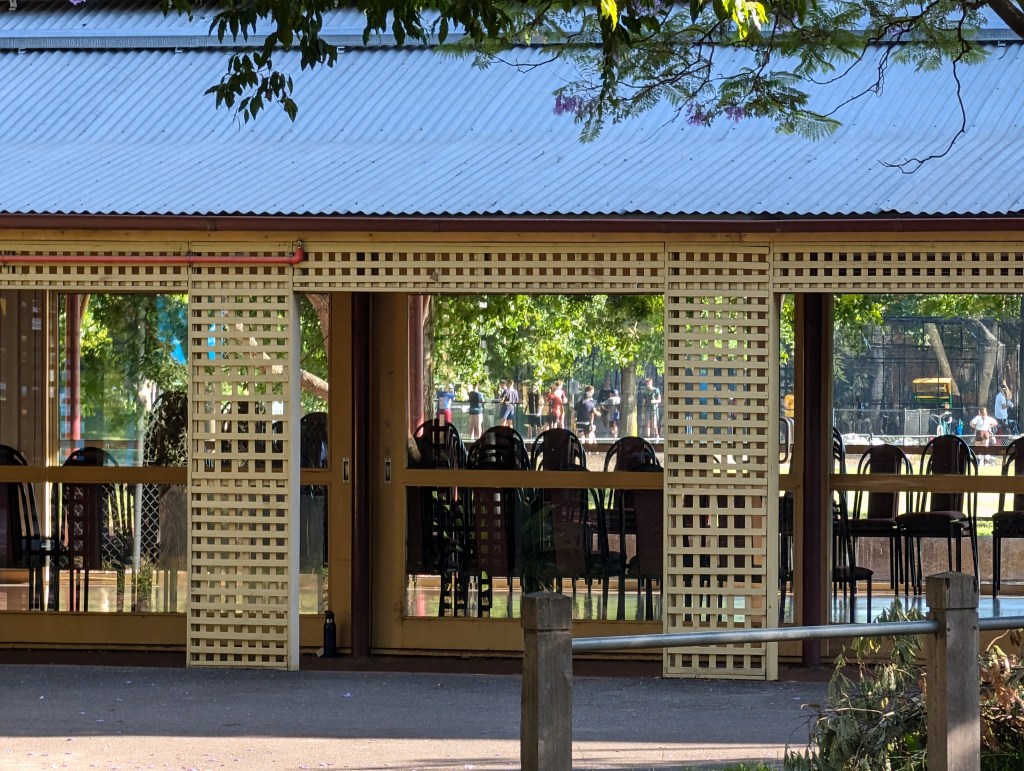
The other disadvantage is loss of the 1980’s community room, which despite its lack of modern ammenties, has a low roof and open aspect that complements the landscape in many ways. Was it’s design influenced by the gatehouse? Like the gatehouse, the glass walls on the north and south walls allow views through the building, and this is the only visual connection between the oval and the formal gardens.
The hulking new football centre on the St Georges Road edge of the oval, won’t sit as lightly on the landscape, blocking views of the oval from the tram, and views of the terraces on St Georges road from parts of the oval. While it will have superior facilities to the community room, it is not clear that the football clubs would share them with the community.
The simple community room by Perter Elliot is of low and light-weight construction and with see-though glass, like the gatehouse. It does not compete with the grandstand. This was to be demolished but is to be retained under the current plan
Option 3 (Not a council option)
This is not in any proposal. The video shows 8 courts laid out to club dimensions with access between the courts.
The line of elms along the former railway are to be removed regardless. While the argument for removing healthy trees is not strong, it is true that these trees don’t have heritage significance. The land to the east of the tennis courts was alienated shortly after the first formal plantings by the railway and now has no (official) significance. The courts would be more visible from the oval. There would be a discontinuation of the north south path to Best Street, but it is very closely aligned to the main bike path from which it diverges. so a single path should work for pedestrians. The bike path along the former railway line would need only minor adjustments.
This is the only 8-court proposal that would preserve the elm avenue.
The disadvantages are that pushing the courts east will expose them more to the gardens. They are now largely hidden by the row of 20th Century elms along the former railway. These trees give shade and character to the tennis club environment, together with the historic trees on the elm avenue to the north. Staying at 6 full amenity courts in Edinburgh Gardens would not have these disadvantages.
While the 2004 Lovell Chen Conservation Management Plan was equivocal about the heritage value of the former railway line, the earlier Swanson landscape study pulled no punches, opening with “As the only substantial area of parkland in Fitzroy, the Edinburgh Gardens deserve particular care. This has not always been the case in the past, and in fact the Gardens have a long history of abuse and alienation of land to other purposes of which the worst episode was sub-division for the State Railways in the late 1880s. Now that the railway has at last been removed, the City is presented with a golden opportunity to reverse this decline and restore the Gardens to their proper role as a well integrated and attractive inner city park serving the passive and active recreation needs of the local community. That is the central theme of this report”The Fitzroy Tennis Club occupies a site of 3r 37p (0.41 hectare), a part of the old cricket club reserve. A formal lease agreement is not at present in force between the Club and the City, but rates are paid. Site improvements are principally the six en-tout-cas courts, the clubhouse and the enclosing fence. The club is unobtrusively sited in the area behind the grandstand and the mound; avenue elms and peripheral landscaping partly screen it from view.The club is a good example of an intensively used sporting facility that has been intelligently sited and grouped with other sporting facilities to preserve the open space values of the surrounding parkland.
Without doubt, the best feature of the Gardens today is the canopy of mature exotic trees that dates in large part from the late nineteenth century. These trees are mostly planted in avenues along the path system of slightly earlier date which links to the surrounding streets and perpetuates the through-passage needs of the pedestrians of that era. Paths and trees provide the basic design and structure of the park which, although pragmatic in origin and essentially uninspired, are characteristic of many of the simpler town parks of its period and well worth preserving.
Conservation Management Plan, 2004, by Allom Lovell [Now Lovel Chen]
Conclusion Activities which have potential to affect the fabric of the Gardens should be discouraged.
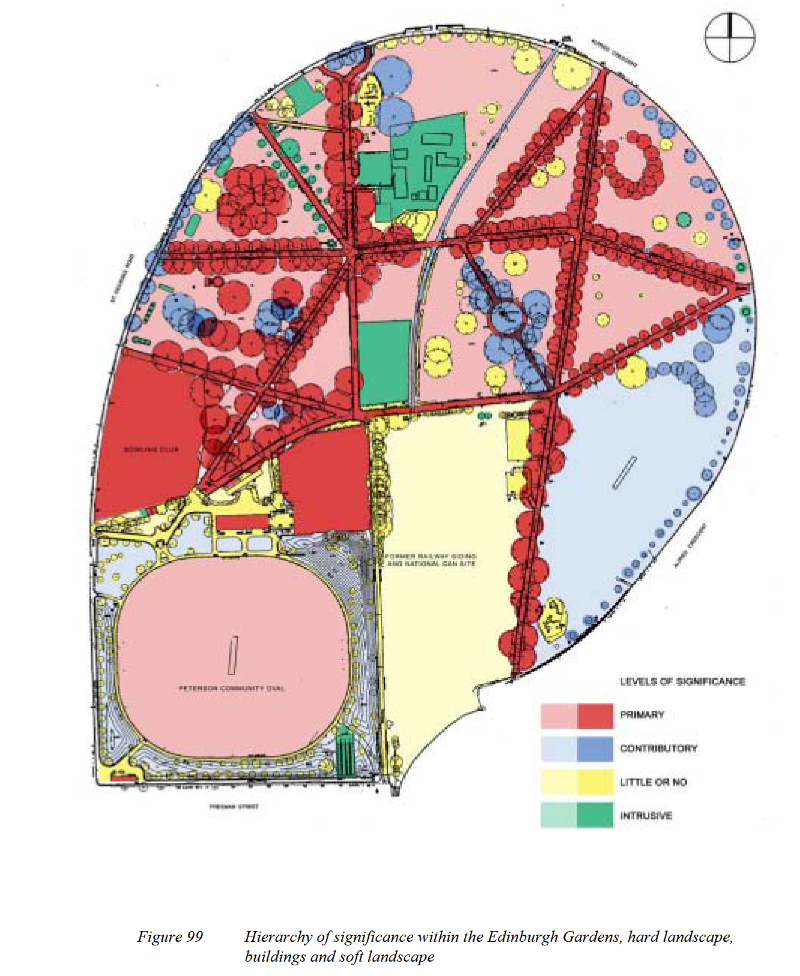
The assessment concludes that the Edinburgh Gardens are of historical, social and aesthetic significance to the City of Yarra. The elements and areas of primary significance include the Elm avenues and rows throughout the Gardens, the Peterson Oval (former Fitzroy Cricket Ground), the English Oak Avenue opposite Rowe Street, the Holm Oak specimen and the remnant Dutch Elm circles. With regard to buildings and hard landscaping features, those of primary significance are the grandstand, the principal nineteenth century path layout and remnant basalt edging, the Freeman Street entrance gatehouse, the timber entrance pavilion, cast iron gas lamp standards and nineteenth century cast iron bollards, the tennis club pavilion and courts (excluding fabric of courts), the Fitzroy Bowling Club (excluding fabric), the war memorial arbour, the Chandler drinking fountain, the pedestal of the Queen Victoria statue and the memorial rotunda.
The conservation policy recognises that continued use of the Edinburgh Gardens for public and private recreation is fundamental to its cultural significance. The conservation policy also recognises that whilst the Edinburgh Gardens retains significant nineteenth and early twentieth century elements, they have in many other respects changed from their nineteenth century appearance. Because of this layering, or co-existence of significant elements, the policy does not encourage favouring one particular phase in the history of the Gardens over others. Policies are instead directed towards conserving significant elements and features from a variety of periods in the history of the place and to remove others, while allowing for some new elements. Overall they are intended to conserve, enhance and recover lost elements of
Significance in the Gardens [CMP2004]
The Edinburgh Gardens is distinctive because of its limited planting palette with its almost exclusive reliance on a single taxon, Dutch Elm (Ulmus x hollandica) for its avenues, and small number of taxa overall. Historically, it did have some ‘gardenesque’ elements with the scalloped garden bed and the Queen Victoria memorial shrub beds, however these have since been lost. The Edinburgh Gardens possibly has more in common with the formality of layout and simplicity of planting palette found in many French formal gardens Several other factors contribute to the aesthetic appeal of the Edinburgh Gardens. These include the nineteenth century character of the northern half of the reserve, mature avenues of elms, a small number of significant specimen trees, views and vistas, the oval and the large ‘oasis’ of green parkland in the built up inner city location.
In summary, the Edinburgh Gardens have pleasant aesthetic qualities which make them a valuable open space within the City of Yarra and inner suburban Melbourne. They have retained a strong nineteenth century character exhibited in their layout, plantings, memorials and recreational facilities which have endured, notwithstanding later phases of development. This is perhaps its greatest strength.
The Edinburgh Gardens are aesthetically significant. They derive their aesthetic significance from their landmark qualities of a large expanse of green within the built-up inner suburbs and their avenue network of mature plantings which impart delightful internal vistas on the space. The focal points of a small number of garden structures also combine to provide an enduring nineteenth century character. The Edinburgh Gardens are unusual as an example of a nineteenth century garden which cannot be characterised into typical Victorian styles of garden design such as the picturesque or gardenesque. The Gardens are the most outstanding example, and one of only two formal nineteenth century gardens, in the former City of Fitzroy and present City of Yarra.
Established for over 140 years, the Edinburgh Gardens are of social significance because of their enduring focus of community use and high regard in which they are held. The Gardens’ continuing social importance and popularity is heightened by its accessibility and provision of passive and active recreational facilities within a dense urban setting and provision for community interaction.
Significance of Tennis Club
The tennis club has an intrinsic historical association with the Edinburgh Gardens, having occupied its present site since c.1888. It is demonstrative of the leisure pursuits of the community since the nineteenth century and which remain popular today. Like other such facilities in the Gardens, it occupies a place in the broader thematic history of the Gardens and the Fitzroy area. The clubhouse, though possibly dating from the early twentieth century, has been modified and apparently relocated variously in the vicinity of the tennis courts. The building is one of the older elements in the Gardens and is similar to the example in the Carlton Gardens.
The tennis courts have been altered and resurfaced a number of times and as such their fabric is considered to be of little or no significance. However their existence and location date from at least 1901 and as such they are demonstrative of the leisure pursuits of the local community since 1888. As an entity the tennis courts and pavilion are considered to be of primary significance. [CMP]
Significance of Paths With the exception of the removal of a number of secondary paths and the alteration to paths around the community oval, the main path network through the Edinburgh Gardens remains essentially unchanged since its creation in the 1880s and 1890s. The principal path structure is of primary significance to layout, but not the majority of materials. However, remnant early basalt scoria rock path edging is of contributory significance. [CMP]
Significance of the Elm Avenues The Elm avenues are of primary significance as a major element of Edinburgh Gardens which dates from its early development in the mid-1880s to the early 1900s, and which remains substantially intact. The Elms are also significant as the overwhelmingly dominant species in the early planting scheme. The almost exclusive reliance on a single species is unusual in Melbourne’s nineteenth century parks and gardens where a broader planting palette was typical. The Elm avenues are also significant as a good example of a traditional ornamental use of this species; which is increasingly rare with the loss of most European and North American examples as a result of Dutch Elm Disease [CMP pg83]
Brunswick Oval Needs Analysis, Lovell Chen July 2019
The Brunswick Street Oval Precinct site is in the south-west quadrant of the Edinburgh Gardens in North Fitzroy. It is bounded by the W T Peterson Community Oval and associated mounded terraces to the south and west and garden paths to the east and north.
The brick wall with a stepped parapet at the east end of the [community room] building was originally a hit-up wall for the tennis club which was incorporated into the design



 The 3068 Group