
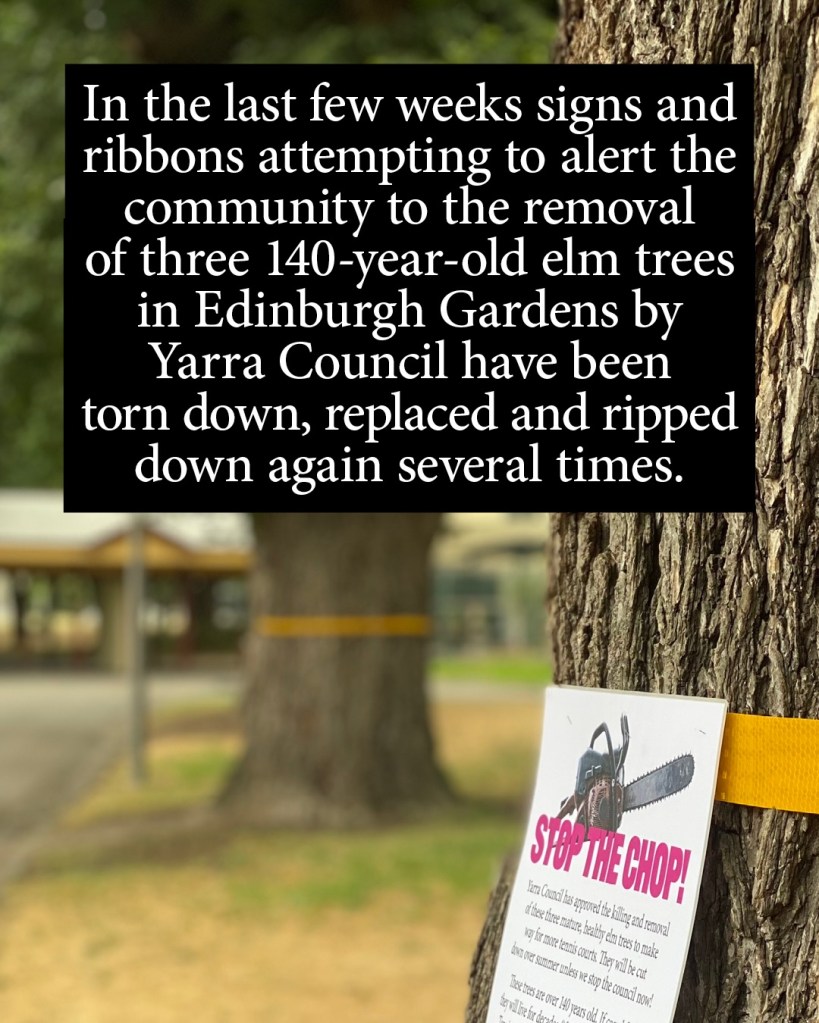
| On Friday, the 3068 Group wrote to the Minister of Planning, asking for a stay of execution on the 140 year old avenue of elm trees in Edinburgh Gardens because the necessary legal right to occupy the land for Tennis is not settled. While the 3068 Group and the broader community support the redevelopment of the Brunswick Street Oval grandstand and improved facilities for community and women’s football, the proposed expansion from six to eight tennis courts involves the destruction of heritage-significant English Elms and a potential breach of the Fitzroy (Edinburgh Gardens) Land Act 1967. The Edinburgh Gardens are on Crown Land, permanently reserved for a “Public Park and Garden … and for no other purpose whatsoever”. This is land ‘owned’ by the crown, not council. The City of Yarra is appointed as the committee of management with limited powers to manage the land in accordance with the Crown Lands Act 1978. A creek through the gardens would have been important to the aboriginal people who have never ceded the land. It was turned into an underground drain when the railway was built in 1888. Three ancient river red gums remain. Under the Fitzroy (Edinburgh Gardens) Land Act, specific areas are mapped out for purposes such as tennis, bowls, cricket and football. The legislation formalized the boundaries between the gardens and sports clubs. These boundaries were largely established in the 1880s when the elm avenue was planted. The 1967 legislation was required because there was no legal right to lease Crown land reserved for a park and garden for any other purpose whatsoever. This became an issue after the Fitzroy Lions VFL club stopped playing at the Brunswick Street Oval in 1966. |
 |
| In the early 1880’s, the sports clubs sometimes blocked access to the public by erecting fences and charging admission. But when they prevented free passage through the gardens between the east (Rowe St) and the west (Brunswick St) there was an outcry. Since at least 1884, the elm avenue beside the tennis courts and grandstand has allowed free passage even during home games. The shaded avenue today still connects Rowe Street with the tram stop on Brunswick Street. The tram stop is the only public transport servicing the precinct but is not a DDA compliant raised stop. The proposed new tennis courts fall outside the area nominated for tennis. As such, we believe the City of Yarra proposal to extend into Edinburgh Gardens is ultra vires (beyond its powers). This mirrors a 2008 proposal to build a library in these Gardens, which was abandoned after the Department of Sustainability and Environment advised Council that a library was inconsistent with the Crown land reservation without enabling legislation. The same legal principle applies here: the land is reserved for a “public park and gardens … and for no other purpose whatsoever”. Since the establishment of the colony of Victoria, the government has reserved land for specific purposes as Crown Land. In all cases the purpose of the reservation is clear. Be it a hospital, school, race course, conservation or a state forest. For example, Mayors Park is reserved for Park and Recreation, so the council can lease part or all of Mayors Park to a tennis club, gym or swimming pool without requiring a change in legislation. However an attempt to locate a swimming pool in Darling Gardens in the 1970s was blocked, because Darling Gardens, like Edinburgh Gardens, is reserved for a garden, not recreation. A Ladies’ Croquet club was also blocked in 1927 for the same reason. [Darling Gardens Cultural Significance and Conservation Policies] The current project is seeking to destroy at least three heritage-protected English Elms planted in the 1880s. In a Climate Emergency, destroying mature canopy that provides vital cooling and mitigates the Urban Heat Island Effect is counter-productive. While council are planting new trees, the truth is that North Fitzroy’s canopy is at the same level as it was following the millennium drought of (2009-2010) caused massive urban die backs. Since 2011 it has gone from 21.6% to 21.9%. Council tree planting has merely kept up with the losses due to development. Another example is the loss of canopy in the proposal to convert Alexandra Parade’s green medium into a car park. This car park will allow sports clubs from all over Melbourne to drive to Fitzroy and play teams from other parts of the city in the new indoor Sports facility at the Gas Works. The Gas Works will not have its own canopy for decades if the planter boxes are successful. Still North Fitzroy is blessed compared to Fitzroy, who’s canopy has reduced since the drought from 15.8% to 15.1% while Collingwood has held steady at a very low 12%. |
 |
| The expansion of the tennis courts into Edinburgh Gardens has not been properly weighed against alternative sites, such as the more popular Mayors Park Tennis Centre, which offers significantly better accessibility and expansion potential. Mayors Park has ample parking, is close to Clifton Hill Railway Station and the Bus and Tram Interchange on Queens Parade (also not accessible). The 504 bus stops within metres of the courts on Hoddle Street and there are two new accessible EV charging bays at the leisure centre. The park was reserved in 1864 and contains a collection of significant palms and elms, but does not have any heritage protection. Edinburgh Gardens is the most popular open space in Yarra – particularly valued by apartment dwellers. The gardens are the closest open space to the nearby Fitzroy Gasworks redevelopment of 1400 apartments – adding to the demand. This is not the only large residential development in the area. Our published analysis of court bookings shows that Mayors Park Tennis Centre hosts more bookings than Fitzroy Tennis Club, Even so, the existing six courts at both centres have considerable unused capacity every day. We asked the Minister to defer the removal of the three heritage-protected trees until the legal status of the Crown Land use is confirmed. We also asked the Department to provide their rationale as to why this proposal does not breach the Fitzroy (Edinburgh Gardens) Land Act 1967 and Section 8 of the Crown Land (Reserves) Act 1978. We also asked for copies of permits already granted as the does not seem to be any public record of them. We also asked the Minister to Commission a transparent heritage review of the impact of the project on Edinburgh Gardens. The 3068 Group has a long history of working constructively with the government—notably contributing to the successful Bargoonga Nganjin North Fitzroy Library after the Gardens were protected from this development in 2008. We seek a similar common-sense outcome here that provides for sport without sacrificing our heritage park and garden. If you feel uneasy about the prospect of losing part of Edinburgh Gardens your best chance of make an impact is by contacting your Councillors and the Minister and by sharing your concerns with friends and neighbours. |
 The 3068 Group