
Object to the tallest building proposed in Clifton Hill.
The number of objections is closely monitored by decision makers.
How to Object
Its easy to lodge an objection with the City of Yarra’s online objection form.
Or send an email to PlanningAdmin@yarracity.vic.gov.au.
An objection must refer to the application PLN19/0845 592 – 622 Smith Street and 2 – 12 Alexandra Parade and 1 – 7 Reeves Street. This is automatically filled out if you follow this objection form link then click on Lodge an Objection
You must include your name and address and the reasons you object.
If you wish, just include the following points. It only takes a minute.
- The proposed building is far too tall for the precinct and will have wide ranging impacts.
- Dominance, overlooking, noise and light intrusion will impact the amenity of many historic properties to the north and east.
- Proposal is privatising public spaces, roads and lanes.
- Traffic from the proposal should be directed to Alexandra Parade and not be allowed to flow into Council Street.
- Affordable Housing should be provided.
- Demolition of heritage buildings should be refused.
What is Proposed?
The Foundry is a proposed 12 storey development in Clifton Hill, on the corner of Smith Street and Alexandra Parade. It will house commercial and retail space, including a large supermarket and fresh food market and casual dining precinct across three levels. The development will comprise three portions, each made up of four, nine and 12 levels respectively and a 3 level car park.
“Fortis Development Group is seeking planning approval for two towers with 23,000 square metres of office space, and 7000 sq.m. of retail.
The subsidiary of Sydney based Pallas Group, in conjunction with another landowner, has amassed control over at least seven buildings giving it a large 6,500 sq.m. block. The five properties on the corner of Smith Street and Alexandra Parade and Reeves Street, include a historic former foundry. Several of the site’s buildings were purchased by the state to make way for the East West Link tunnel, and were subsequently sold.” [AFR, March 2020]

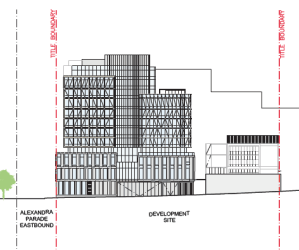
The site is about one sixth the size of the Former Fitzroy Gasworks on the opposite side of Smith Street. In contrast to the Gasworks site, the state government has not placed any height controls on these sites, despite their being much closer to the historic neighbourhood around Council Street. The government has not done any soil contamination assessment, nor has Yarra Council demanded an audit of existing contamination.
Our Objection
The 3068 Group is objecting to this proposal, with detailed objections on Amenity, Traffic, Heritage and Urban Design grounds. We are recommending that members and local residents also submit objections before the proposal is considered by Council’s Internal Development Assessment Committee (IDAC) in the coming cycle.
12 stories plus two stories of plant and equipment (55m) is much too high. Buildings greater than six stories have negative impacts felt far away. The buildings should not be taller or set back less than what is allowed on the Gasworks site, and should follow the Smith Street height controls adopted in Amendment C231 (18m mandatory).
Privatising public lanes should not be supported.
Dominance, overlooking, light pollution and sound intrusion, from proposed east-facing and north-east corner open terraces on levels two through eight will detrimentally impact 148 properties, including those beyond the arbitrary statutory limit of 9 m.
The buildings will be ten times the height and more than ten times the width of the private open space of the single-fronted, single-storey houses which comprise half of the houses to the east of the subject site.
Sustainability
The Application Fails to consider longer term goals of sustainability to build ethical, diverse cities and spaces with spatially aware citizens that would turn the land into a mixed-use suburb, bristling with activity at ground level, rather than the wind-swept settlement of monolithic offices, wide boulevards and hard-edged buildings that are the result of short- term commercial thinking.
Objection is made to the detrimental effects from the height of the proposal on the heritage value of Clifton Hill West Heritage Overlay HO317.
The majority of impacted dwellings are single-storey properties, most are earlier than 1890 and many are earlier than 1870. Modest wooden workers cottages are common.
Objection is made to the detrimental effect on the heritage value of Smith Street.
Facadism is no excuse for heritage destruction.
The proposed tower will disrupt an important landscape view of the internationally recognised heritage shot tower, framed by Napier Reserve (bordered by Alexandra Parade and Queens Parade) and the treed median of historic elms along the length of Alexandra Parade.
Traffic from the site should not be allowed into Council Street.
Vehicle access to Council Street will have an unacceptable impact on the Clifton Hill Western precinct.
A left-in, left-out vehicle access to the site should be provided on Alexandra Parade, with only loading bays on Reeves Street and no truck access to Council Street.
The proponent has not justified the request for a waiver of parking from the statutory 936 places to the proposed 352 places.
The height should not exceed 18 metres (based on C231 Smith Street Precinct 3). It should certainly not exceed the Gasworks mandatory height limit of 10 storeys.
The valued low-rise character of the heritage area should be retained. Non-heritage sites should be redeveloped in scale with surrounding buildings.
The development should fit with its context and the preferred future character.
The street façade on Smith Street should not exceed three storeys or 12 metres with higher development set back a minimum of 8 metres.
Development above street façade height should be setback and the scale should be subservient to contextual buildings along Smith Street.
The development should provide for a range of dwelling types to cater for a variety of housing needs including the provision of up to 10% of dwellings as affordable housing.
An assessment of the level, nature and distribution of any contamination within, or in close proximity to, the land, is required.
 The 3068 Group