
How Yarra botched the heritage assessment of the former St Andrews Sunday School Hall in Clifton Hill
When the 3068 group first looked at the plans for Sambell Lodge, we were shocked to see that the St Andrews Church and former sunday school hall was proposed to be demolished.
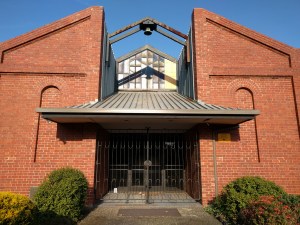 Not only is it a contributory building, but it ‘s one that is well built and well liked by the community. The tall arch windows facing onto a northerly open area is my favourite feature.
So how does a developer get away with demolishing a contributory church building? We asked the developer, none other than the Executive Director of the Brotherhood of St Laurence. ‘Oh Yarra told us its not a heritage building’.
This striked us as a very odd, since every building in Yarra has a heritage listing, and you can look it up, and this building is listed as ‘Contributory’. These gradings were applied Graeme Butler in 2007 in a heritage study that was designed to clean up the sloppy 1999 study by Alom Lovell, (now Lovell Chen). That study led to endless disputes about what was and wasn’t heritage and generated a great revenue stream for lawyers and heritage advisors. Butler accessed every building in every heritage precinct in Yarra and used an objective methodology to come up with the gradings. So far, few mistakes have been reported. Of course there are debates about some gradings.
What does contributory mean?
Contributory: The place is a contributory element within a larger heritage place. A contributory element could include a building, building groups and works, as well as building or landscape parts such as chimneys, verandahs, wall openings, rooflines and paving.
One area in which the Butler study was ruthless was in assessing modified buildings. Many historic buildings were graded as non-contributory because the modifications were of a nature that they no longer contributed to the character and they could not be restored.
Clearly this 1905 sunday school hall was assessed against the same criteria and assessed as contributory.
Since Butler’s report there has been a politicisation of the planning department starting in 2006. The Heritage Advisors’ fearless advice was no longer desired. Yarra’s impartial and highly qualified heritage advisors were asked to reapply for their positions on new terms that would make them lackeys of the Director.
If the client wants demolition, and Spring St wants demolition, then demolition is on the menu. The erroneous heritage advice provided to Yarra in this case is a direct outcome of that 2007 decision to go with dial-an-advisor.
This is what the original heritage advice said.
It is assumed that the currently used church building facing Gold Street was built about the same time as the existing three-storey brick hostel.”
The building is obviously architecturally designed and it incorporates various architectural brick detailing that are reflective of earlier architectural styles.
This building is not the original school room building. Given its date of construction, it is considered that the ‘contributory’ status attributed to the current church building is erroneous and should be amended to be ‘non-contributory’.
On the basis that the entire built stock on the subject site appears to date from the 1980’s, it is considered that either full or partial demolition of the site is acceptable.
Diahnn McIntosh DATED: 29 December 2014
You can check the link – we didn’t make it up. Its common to disagree with interpretation but this is wrong in fact.
The only thing you could agree with is that there was an early building on the site – prior to 1905.
The applicant in this case is Brotherhood of St Laurence. They look after people that fall through the cracks and have a very good reputation for this kind of work. You would not expect them to be heritage experts and so they relied on councils expert heritage advice and spent a considerable sum on plans based on Yarra’s faulty advice.
In January 2015, when we met the Executive Director of BSL and pointed out the advice was just plain wrong – we expected they would simply redesign the plans to incorporate the heritage building. After all, its a fine building in very good condition. Miles Lewis reckons the builders used innovative early 20th C structural technology which may explain why the former Sunday school hall is still standing while the church on the corner and its vicarage was demolished in 1975.
It’s not difficult to establish the building dates from 1905. There’s a plaque on the facade with the date. It can’t get any easier than that. There’s also ‘All seats free : a history of the Parish of St. Andrew, Clifton Hill‘ by Sue Cawcutt and Therese Virtue available in the Collingwood Library that would give the history of the building. And Brimstone to Bunyip: churches of Collingwood, Clifton Hill and Abbotsford by Richard Peterson.
In response to community’s outrage at Yarra’s heritage advice two thing occurred. Both Yarra and the applicant engaged separate advice.
Lovell Chen were engaged by the applicant, and provided their own heritage opinion in line with what was requested by the client. This is the same heritage firm that was engaged by Mathew Guy when he wanted to demolish large parts of Clifton Hill for the East-West Link flyover, and who gave the opinion that it was fine to demolish a good part of Gold St Clifton Hill because it was only on the edges and hey – there would still be lots of old buildings left. This is what Lovell Chen had to say:
While full demolition of contributory buildings is not encouraged under Council’s local heritage policy, in this instance the 1905 building has been modified, and on this basis its contributory value to the Clifton Hill Western heritage precinct (H0317) is diminished. While its overall original form is still evident, its presentation to Gold Street is of a modified historic building, with a significant change to its west gabled facade.
The building no longer relates to any historic church buildings on the site. It is also not part of a group of similar buildings, which is a relevant consideration under Clause 22.02. The loss of this building would therefore not have an unacceptable impact on the heritage place, being the heritage precinct.
Demolition is ‘not encouraged’ sounds a bit weak. Here is what the policy in the planning scheme says:
Full Demolition or Removal of a Building
Generally encourage the retention of a building in a heritage place, unless
- The building is identified as being not contributory.
- The building is identified as a contributory building, and new evidence has become available to demonstrate that the building does not possess the level of heritage significance attributed to it in the incorporated document, City of Yarra Review of Heritage Areas 2007 Appendix 8, revised September 2015 and
- the building does not form part of a group of similar buildings
Note: The poor condition of a heritage place should not, in itself, be a reason for permitting demolition.
An application for demolition is to be accompanied by an application for new development.
Note the ‘and’ between the second and third bullets. Clearly the second bullet point is the decider. Whether the building is part of a group or not is a distraction if the second point cannot be established. No new evidence has been provided by either Lovell Chen or Yarra.
The Lovell Chen report says the building’s ‘contributory value is diminished’. But they don’t say it is extinguished, non-contributory or incorrectly graded. It has been diminished since the modifications of 1975, but not since its grading in 2007 which they did not dispute.
There has been no change to the building since it was graded as contributory. Further when the building was graded as contributory, it was already the only remaining building from the church complex. So the argument it no longer contributes to a group of buildings on the site was not relevant to the original grading.
The statement of significance for the Clifton Hill West Precinct(HO317) refers to the five church reserves. There are other church halls such as St Mark’s in Hodgkinson St to which this building forms part of a group from the main development period ‘a with a substantial contribution from the Edwardian-period‘.
The City of Yarra knew their original advice would be shot down, so they commissioned a second independent heritage opinion from Geoff Ashley, Director of Context P/L. Perhaps they expected this would support the agenda to demolish the hall. The second opinion from Ashley finally gives a clear and true picture of the heritage of the place. Context was asked to provide an assessment and opinion as to whether the building at 160 Gold Street Clifton Hill should retain its current Contributory status.
there is abundant physical evidence to conclude that the building is the St Andrews Sunday School that was constructed in 1905 and that it had minor modifications made in the late twentieth century for adaptive reuse as a church…in c1975 by
- the modification of its gable street frontage to create a recessed entrance,
- new windows added towards the rear of the south side and
- new windows and a door added to the north side associated with an brick wall enclosed courtyard.
- The roofing and roof sheeting and gutters were renewed at that time and the interior modified with plasterboard walls to create toilets and kitchen to support the church use.
Not only does the building have Contributory value as evidence of the former St Andrews Church complex, it is also significant as the only remaining structure from that complex and one that was converted for use as a church when the earlier church was demolished. It is therefore possible that the building could be found to be Individually Significant.
Yarra should be rejoicing. Not only is is very much contributory, as Butler identified, not only are the modifications minor, but it may be Individually Significant!
Individually significant – This means the place is an individually important place of State, municipal or local cultural significance.
Wow! That’s something worth exploring. It calls for more study. Better tell the applicant…
Recommendations
Retain the Contributory status for 160 Gold Street Clifton Hill within the City of Yarra Planning Scheme
Undertake further historic research to more specifically identify the changes made to the building in c1975; and
Advise the applicant for PLN PLN14/0678 of the finding that confirms its heritage status and request that on this basis that they consider revision of the scheme to retain the former St Andrews Sunday School, later St Andrews Church, 160 Gold Street Clifton Hill.
“On this basis they consider a revision to the scheme.” That’s not the 3068 Group, that is independent advice commissioned by and for the planning department.
Did the department act on their advice? Did they accept their internal advice was erroneous and tell the developer to redesign based on the correct identification of the building as contributory by one expert (Butler) which is confirmed by another (Ashley) and not disputed by the applicant’s expert (Lovell) who only says it contribution is ‘diminished’?
No. Instead they reached a new low point trying to twist the advice into a recommendation to Councillors.
And this leads to the planning delegation report. A twisted document that councillors are expected to base a decision on.
116. An external heritage consultant was commissioned by Council to provide a ‘second opinion’ on the proposed demolition of the former church building. This was undertaken at the request of objectors and considered appropriate given the ‘contributory’ grading of the building and complexities regarding evident modifications and associated impacts. This external advice compliments that of Council’s Heritage Advisor which is also provided in this report.
Excuse me! Didn’t the second opinion demolish the advice of Council’s Heritage Advisor? Is ‘erroneous’ a compliment? Are heritage advisors too polite? In fact, the advice it complements has been completely doctored to complement the external advice.
The planning department have closed ranks. the department never make mistakes. The original heritage advice can simply be ‘adjusted’ after the fact. Now it says:
141. The main points of difference between the various heritage assessments that have been prepared in regard the former St Andrews Sunday School Hall are:
(a) the impact of the various modifications carried out in 1975; and
(b) the significance of the building as the last remaining structure associated with the former St Andrews church complex.
142. While its form, scale and materials may be generally reflective of its Edwardian origins, it is cannot be denied that the current appearance of the church building makes a contemporary contribution to the historic character of Gold Street. Those building details that actually help to identify the building as an Edwardian building are not generally visible from the street.
Original 1905 details clearly visible from the street
In this regard, it is considered that due to the extent of changes that have been carried out on its façade, the subject building makes a very limited contribution to the historic character and appearance of the street or the precinct as a whole.
143. In regard to its historical significance, it is accepted that the church building is the last remaining component of the former St Andrew church complex. Without any other original associated church buildings, it is however considered difficult to appreciate this aspect of the building’s significance. The building’s contemporary appearance also does little to promote the history of the site.
144. In conclusion, it is considered that the full demolition of the former St Andrews Sunday School Hall, together with all other built structures on the site, will have little, if any, impact on the significance of the heritage precinct which is predominantly characterised by Victorian style buildings with a substantial contribution from the Edwardian-period.
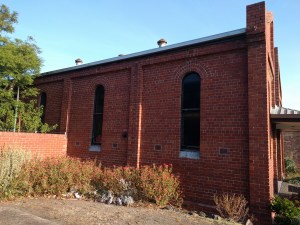
So just because Yarra’s heritage advisor got it wrong in a drive by assessment, the rest of us can’t recognise an Edwardian Sunday School with minor modifications.
Actually, most of the north wall of the building is visible from the street, and in any case, there is much more to heritage than the façade, particularly about a public building with deep social links into the community.
So this is still pretty weak, highly opinionated and they know it. You need a bit more to call for demolition of a contributory church hall in Clifton Hill. And so out comes the net social benefit argument.
248. Although State and local planning policy seek to conserve and enhance heritage places, there is also a recognised place for the removal of buildings where the significance will not be unreasonably eroded. Planning must also consider the matter in the context integrated decision making [sic] that balances competing objectives in favour of net community benefit and sustainable development (clause 10.04).
Whoa! What’s Clause 10.4?
Integrated decision making
Society has various needs and expectations such as land for settlement, protection of the environment, economic well-being, various social needs, proper management of resources and infrastructure. Planning aims to meet these by addressing aspects of economic, environmental and social well-being affected by land use and development. Planning authorities and responsible authorities should endeavour to integrate the range of policies relevant to the issues to be determined and balance conflicting objectives in favour of net community benefit and sustainable development for the benefit of present and future generations. Consistent with the objectives of local government under the Local Government Act 1989, municipal planning authorities are required to identify the potential for regional impacts in their decision-making and co-ordinate strategic planning with their neighbours and other public bodies to achieve sustainable development and effective and efficient use of resources.
No actual mention of removing heritage buildings there. So what are the ‘conflicting objectives’ here? Wouldn’t retention and reuse of a structurally sound Edwardian era hall ‘achieve sustainable development and effective and efficient use of resources’?
Is there any real conflict between the development objectives and retention of the hall? Does demolition really ‘facilitate the transfer of residents from the existing building to the new building’. They are never going to live in the vacant hall?
And then this. After 250 paragraphs of planning recommendations that make no mention of the school purchase except to repeats supporter’s (irrelevant) comments, we get the next facilitation argument:
The Brotherhood of St Laurence is currently negotiating with the State Government/Department of Education for the land where the existing building is to be sold so that it can be development and used as part of the Gold Street/Clifton Hill Primary School. The additional land and buildings are needed to accommodate a predicted increase in children aged 5-14 from 5033 in 2011 to 10,995 in 2031.
251. The demolition of the former church building would have an impact on the heritage significance of the area given its remnant Edwardian features and numerous connections community members have to its past. However, that impact is considered to be limited and acceptable given evident modifications to the building’s form, the primary significance features of the area, the contribution the new development would make to a range of important State and local strategic planning imperatives, opportunity to provide additional land to a public primary school.
This is a political recommendation from a politically driven planning department.
The applicant’s proposal is to build a near identical multi-purpose space directly to the north of the historic building. There are no competing objectives here, just a failure of imagination.
A study is required to determine if the building is individually signficant. There’s no compelling argument to demolish it, and plenty of information to give pause to such a reckless proposal. Retaining the building would lead to a better proposal.
Chris Goodman
March 7 2016
 The 3068 Group